
Key Differences Between Dyeing and Printing Processes in Textile
Dyeing and Printing are two different processes and different applications in the textile industry. Key Differences Between Dyeing and Printing Processes in the Textile Industry.
Dyeing
A dye is a coloring material that is used for presenting color to exclusive materials or changing the color of something. Dyes have chromophores and auxochromes, which are responsible for their colour and substantivity. Dye, a substance used to impart colour to textiles, paper, leather, and different substances, such that the colouring isn’t readily altered by washing, heat, light, or different elements to which the material is likely to be exposed.
Dyeing is one of the very important departments of the textile sector. All kinds of yarn, fabric are dyed by applying dyeing application, where the liquor ratio is higher than the printing. It should be noted here that color penetrates through the fabric by applying dye. It is also a cheaper process than printing.
Printing
Printing is normally done on a fabric surface where the liquor ratio is lower than in dyeing applications. In the case of the printing method, the curing process is necessary. Another thing is that printing is a costly process than dyeing.
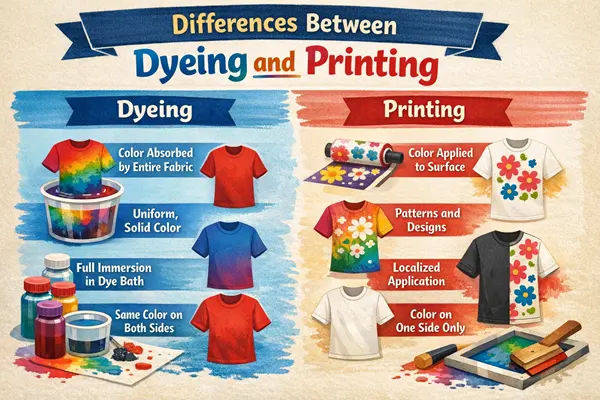
Key Differences Between Dyeing and Printing Processes in the Textile Industry
Key Differences Between Dyeing and Printing Processes in the Textile Industry in the following:
| SL No. | Dyeing | Printing |
| 01 | In the case of dyeing, dyes are applied to the whole fabric with equal quantity. | In the case of printing, dyes are applied in the definite parts of fabric for producing design. |
| 02 | During batch application, more time is required. | Less time is required than dyeing application. |
| 03 | Here, the liquor ratio is higher. | Less liquor ratio here than dyeing application. |
| 04 | Precise temperature is needed here. | Precise temperature is not needed in the case of printing applications. |
| 05 | A curing or steaming process is not needed here. | The curing or steaming process is needed for printing applications. |
| 06 | Thickener is not used here. | Thickener is widely used here. |
| 07 | Not expensive. | Expensive. |
| 08 | Here, color penetrates throughout the fabric. | Here, color is applied only on the fabric surface. |
| 09 | The fabric becomes soft after dyeing application. | Printed fabrics will be harsh and hard after applying the printing application. |
| 10 | The quantity of water is required more here. | Less amount of water is needed here. |
| 11 | Only one dye is used in the case of dyeing application. | Here, one or more dye is used during the application of printing. |
| 12 | Half bleaching is enough for fabric preparation before applying the dyeing application. | Full bleaching with optical whitener is needed in case of printing application. |
| 13 | Dye solution concentration is less in the dye bath. | Printing paste concentration is higher in printing. |
| 14 | Fibers, yarn, and fabrics are dyed by applying the dyeing application. | Normally, printing is done on a fabric surface |
| 15 | Precise design is not needed here. | Here, precise design is a must needed |
Dyeing results in a colored fabric, whereas printing results in a patterned fabric.