
Differences Between Natural Fiber and Man-made Fiber
Fibers are an important factor in making textiles. Two types of fibers are available. One is a natural fiber that we get naturally from plants or animals. Another is man-made fiber or synthetic fiber that is made by men using different processes like melt spinning, dry spinning, or wet spinning. The fiber-forming substances have to be manufactured by chemical methods instead of growing in fields. Because of this, man-made fibers are also called chemical or manufactured fibers. The fiber-forming substances are usually made from wood pulp, cotton linter, petrochemicals, or natural gas.
All the fibers cannot be textile fibres due to being textile fibers (natural fibre and synthetic fiber) it should possess some significant qualities. It should have sufficient strength, fineness, length, elasticity, crimp, and friction power to protect against the effects of biological agents, etc. It should be available too.
Cotton, jute, etc., are textile fibers as they have the above characteristics, but fibers of the banana tree are only fibers and not textile fibers, as they do not possess strength, elasticity, appearance, etc. This is why we can say that not all fibres are textile fibers in the spinning industry.
Natural Fibers:
In the textile industry, the fibers that are obtained from plants, minerals, or animals are known as natural fibers. Different types of natural fibers are hemp, wool, etc.
Man-Made Fibers:
The fibers, whose chemical composition, structures, and properties are significantly modified during the manufacturing process in the textile industry, are termed man-made fibers. Different types of man-made fibers are Nylon, polyester, etc.
Advantages and Disadvantages of Natural and Man-made Fiber:
The natural fiber and man-made fibers have their own merits and demerits depending on the purpose of their use. By and large, they can be stated as follows:
- The emergence of Nylon established a miraculous fiber strength that could not even be imagined for the natural fibers. All kinds of synthetic fibers, produced in succession to it, also had almost the same level of strength, and this is the strongest point of the man-made fibers. However, in contrast to this, the objects of regenerated fiber series (for example, rayon) are quite inferior to natural fibers.
- The peculiar forms, created naturally in the growing procedure of fiber, such as the hollow and natural strands of cotton fiber, crimps of sheep wool, scales, felt characteristics, etc., cannot be created in man-made fibers, even after using the latest scientific technology. This mysterious excellence is the strong point of natural fibers.
- There is a special charm in natural fiber that has kept it in great demand in recent years. For clothes, it is in demand due to its merits from the point of touch, such as being warm, having a good feel, and being comfortable.
- Apart from the quality, if one sees from the economic point, the balance of demand and supply is governed by the condition of climate and farmland in the case of natural fiber. But, in the case of man-made fiber, human operation is easy. Moreover, the fibers of the regeneration series can have a self-sufficient supply of domestically produced raw materials to a certain extent, and so their prices can be relatively low.
- In the case of natural fiber, it costs more to produce and buy. Textiles made from natural fibres tend to be more expensive than man-made fibers.
- Natural fibres are softer and absorbent than man-made fibers. Cotton is more comfortable next to the skin due to its high absorbency and softness.
- Experience higher levels of wear and tear. Since their natural state is not compromised during production. It means that natural fibres have less endurance and strength than synthetic fibres.
- Higher endurance to heat in the case of natural fibers. Whereas synthetic fibres will melt when exposed to fire, natural fibres will endure high heat.
- Man-made fibers are highly elastic and easy to blend with other fibers. Fabrics such as spandex are very elastic and are often blended with other natural fibres such as cotton to make exercise wear and other stretchy cotton apparel.
- In the case of man-made fibers, their production is not eco-friendly. The chemical processes involved in producing synthetic fibres result in environmental pollution than natural fibers.
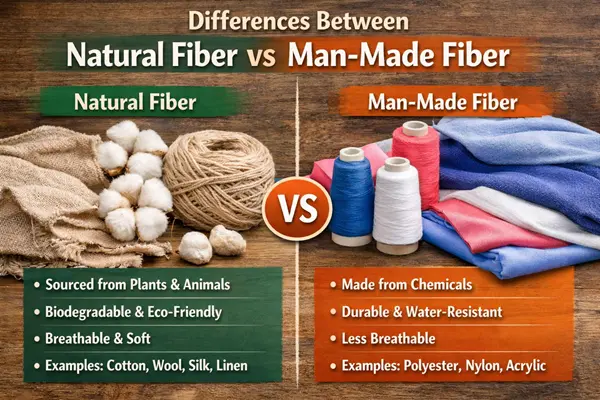
Difference Between Natural Fiber and Man-Made Fiber
Here are 21 key Differences Between Natural Fiber and Man-made Fiber:
| SL No. | Natural Fibre | Man-Made Fibre or Synthetic Fiber |
| 01 | The fibers which we get from nature are known as natural fiber. | The fibers which are developed by man are known as man-made fiber. |
| 02 | It is comparatively less durable. | It is comparatively more durable than natural fire. |
| 03 | For natural fibre, we have to depend on nature. | It can grow everywhere. No dependence on nature. |
| 04 | Number of molecules is controlled by nature. | No. of molecules controlled by man. |
| 05 | The fabric made from natural fibre is more comfortable and also good for health. | Man-made fibre is not comfortable and good for health as natural fiber. |
| 06 | Normally, natural fibers are hydrophilic. | Man-made fibers are hydrophobic. |
| 07 | It is hygienic. | Some are not hygienic. |
| 08 | It is expensive. | It is cheaper than natural fibre. |
| 09 | The length cannot be controlled here. | Length can be controlled. |
| 10 | It is not favorable for finishing. | It is favorable for finishing. |
| 11 | Here, no need spinneret. | Spinneret needs to produce filament. |
| 12 | It is easy to dye. | It is not easy to dye. |
| 13 | Uses of natural fiber are limited. | There are so many uses of man-made fibers. |
| 14 | No spinning process is required to produce filament. | The different spinning processes like melt, dry, wet etc. are required here. |
| 15 | Natural crimp remains here. | No natural crimp remains. |
| 16 | Impossible to change structure. | Possible to change structure here. |
| 17 | In most cases, scouring and bleaching are done. | Very often, bleaching and scouring are done. |
| 18 | Dust and trash remain in fibre. | No dust and trash are remained. |
| 19 | It comparatively has less lifetime. | It comparatively has more lifetime. |
| 20 | Natural colors are found here. | No natural color is found here. |
| 21 | Contains natural crimp or convulation | Crimp is given by men |
So we understand, there are significant Differences Between Natural Fiber and Man-made Fiber. The manufacturing process is quite different, and outcomes are too. The good thing is, both types of textile fiber have uses for fiber, yarn, and Fabric.