
Different Types of Textile Lab Testing
The process to determine the properties of different kinds of textile substances is known as textile testing. Textile testing is one of the most important departments of a manufacturing factory. Buyer requirements should be followed by using these instruments before shipping the order. Otherwise, the buyer may cancel the order due to the poor quality of the product. A successful TTQC department can earn respect and belief from the manufacturing factory. This article is all about the Different Types of Textile Lab Testing available in the Textile and apparel industry.
Textile testing is the process of measuring the attributes and features of the circumstances influencing textile fiber, yarn, and materials by using science and engineering knowledge. It entails utilizing methods, equipment, instruments, and machinery in a lab setting to assess the characteristics of various textile forms (thick, thin places).
Textile lab testing is crucial in the apparel industry to ensure products meet safety, quality, and legal requirements. It helps detect defects in fabric, adhering to global standards like ISO, BS, Oeko-Tex, and ASTM. Textile testing also helps avoid liability or recall by identifying potential issues before they become problems. By adhering to these standards, brands and retailers can ensure their products meet consumer expectations and meet the industry’s standards.
Objectives of Textile Lab Testing:
The main purposes of testing are-
- Research,
- Selection of raw materials,
- Process control,
- Product control,
- Process development,
- Product development,
- Specification test.
Why Testing?
Since you, the consumer, desire it.
benefits of textile testing:
- Reduces the risk for every stakeholder in the supply chain, including high-end merchants, manufacturers of yarn and fabrics, and final consumers.
- Minimizes expensive errors and verifies the quality of textile products at every stage of the production process.
- Restricts any liability to the buyer.
- Give your unbiased, professional opinion.
- Aids in maintaining control and enhancing processing speed.
- Assist with research and development.
For what reason do we conduct Textile testing??
The majority of textile and apparel industries look for:-
- Safety
- Legality
- Performance
1. Safety:
- Sharp point
- Sharp Edge
- Button pull test
- Drawstring length for kids garments.
2. Legality:
- Banned amines
- Fiber content
- Formaldehyde content
- Nickel content
- Flammability
Chemical Testing Laboratory
3. Performance:
- Color fastness to Washing, Light, perspiration, etc.
- Dimensional stability to washing, dry-cleaning, etc.
- Skewness
- Abrasion and Pilling
Key factors affecting the Testing Results:
- The Sampling.
- Atmospheric conditions during testing.
- Method of testing.
- Instruments used in testing.
- Efficiency of the technique.
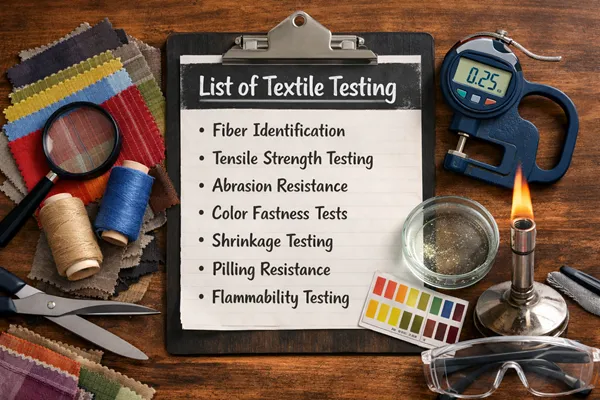
Different Types of Textile Lab Testing Standards :
Different types of textile testing for the textile and Apparel Industries:
Textile testing is a crucial process in the textile and apparel industries to ensure the quality and durability of products. The predominant laboratory tests conducted in the garment or textile sector include:
1. Color fastness testing of Textile:
Resistance to fading refers to a dye’s capability to retain its color despite exposure to elements like light, perspiration, air gases, or washing. These factors can potentially remove or damage the color, but a dye with good resistance will remain vibrant.
2. Air permeability testing of Textile:
Air permeability is the measure of the speed at which air flows across a specific area under particular conditions of pressure drop and time. The test principle involves measuring the rate of flow across the fabric test area within a specific time period, at a particular pressure difference. In the textiles and clothing industry, professionals frequently use air permeability to assess and compare the breathability of different fabrics, both coated and uncoated. This evaluation is particularly relevant for products like raincoats, tents, and uniform shirting. It aids in assessing the efficacy of parachutes, sail cloth, industrial filter fabrics, and the materials used to cover cushions.
3. Flammability testing of Textile:
Flammability refers to the capacity of a substance or item to ignite and sustain combustion when subjected to specific testing conditions.
4. Fiber Identification testing of Textile:
To differentiate various types of fiber, experts use two distinct methods. The non-technical tests and the technical tests. The non-technical test consists of a sensation test and a burn test, whereas the technical test consists of a microscope test and a chemical test.
5. Physical and Mechanical Testing Of Textile:
The fiber type, yarn construction, fabric structure, and any applied treatments all have an impact on the physical and mechanical qualities of these fabrics. Various fabric performance parameters are evaluated for different applications. Fabrics differ from other uniform substances as they are composed of diverse components, making them heterogeneous materials. It is crucial to acknowledge that the three key components for any test are the sample technique, the conditions of measurement, and the equipment used. The examination and evaluation of the physical and mechanical properties of textiles encompass the subsequent tests-
6. Tensile Strength Testing Of Textile:
This is the highest documented tensile force applied to a test piece until it reaches the point of breaking. The measurement of tensile stress-strain properties is the predominant method for assessing the mechanical characteristics of fabrics. To ascertain how a specimen responds to a uniaxial tensile force, experts utilize a tensile strength test. From this, they can derive the breaking load and elongation. The test follows a straightforward principle: securely hold the test specimen at two or more points and gradually stretch it until it breaks. It is also known as a Universal Testing Machine (UTM).
7. Tear Strength Testing Of Textile:
This test method determines the tear force required to propagate a single-rip tear of defined length from a cut in the fabric when a sudden force is applied.
This method applies to fabrics which do not tend to tear in a direction crosswise to the direction of force applied. Hence it is mainly applicable for woven fabrics. In general the test is not applicable to knitted fabrics and woven elastic fabrics. It is not suitable for highly anisotropic fabrics or loose fabrics where tear transfer from one testing machine
8. Seam Strength Testing Of Textile:
There are two geometric shapes utilized for the seam strength test: transverse and longitudinal. These shapes are depicted in the accompanying image. Method A, known as the transverse direction, is suitable for materials that are relatively inextensible, such as woven and stable warp knit structures. The longitudinal orientation (Method B) is suitable for extensible textiles, such as knitted, elastic, and very resilient fabrics. The test specimen is positioned centrally between the upper and lower jaws, with the seam oriented either perpendicular or parallel to the jaws, depending on the specific test procedure. The sample is thereafter elongated at a consistent pace until it experiences rupture.
9. Seam Slippage Testing Of Textile:
Seam slippage refers to the inclination of a seam to separate when a force is applied in a direction perpendicular to the seam’s alignment. It can occur in a garment or household item due to various factors.
10. Burst Strength Testing Of Textile:
Tensile strength tests are typically employed for woven materials, where there are clearly defined warp and weft directions in which the strength can be quantified. However, specific textiles, such as knitted materials, possess distinct characteristics. Lace or non-woven materials lack clear orientations where their strength is maximized. Bursting strength is an alternate technique for assessing the strength of a material, where the material is subjected to stress in all directions simultaneously.
This method is particularly appropriate for materials with such characteristics. Additionally, there are textiles that experience stress from all directions during use, such as parachute fabrics, filters, bags, and nets. In these cases, it is crucial to subject them to realistic levels of stress. A fabric is more prone to failure due to bursting during use rather than breaking through a straight tensile fracture. This is because the tension exerted at the elbows and knees of clothes is of the bursting kind.
11. Abrasion Resistance Testing Of Textile:
Abrasion refers to the erosion of a fabric caused by friction with another surface. Throughout their lifespan, fabrics undergo abrasion which can lead to wear, degradation, damage, and a decline in performance. Nevertheless, the capacity to withstand abrasion is just one of several aspects that influence the overall wear performance and durability.
Classification of Textile Lab Testing:
There are different types of testing followed in manufacturing industries, which are pointed out below:
- Routine process testing,
- Quality record testing.
All the above testing has been explained in the following:
1. Routine Process Testing:
The testing whose results can be obtained very quickly in the working field is known as routine process testing. Routine testing helps to make quick decisions.
2. Quality Record Testing:
The testing result is to be recorded for various objects to finish the work is known as quality record testing.
Textile Testing Lists Followed in the Manufacturing Sector:
There are mainly three types of testing followed in the manufacturing industry are-
A. Fibre Test List:
- Grading test,
- Identification of fiber test,
- Strength and elongation, i.e., tensile strength test,
- Maturity test,
- Fiber length test,
- Linear density or fineness test,
- Trash, Neps test, etc.
B. Yarn Test List:
- Twist per unit length test,
- Yarn count or linear density test,
- Appearance test,
- Hairiness test,
- Strength and elongation, i.e., tensile properties test,
- Evenness and regularity test.
C. Fabric Test List:
- Width test,
- Thickness test,
- of ends per unit length test,
- Tensile properties, i.e., strength and elongation test,
- Design and construction of the cloth test,
- Crease resistance and recovery test,
- Shrinkage test,
- Abrasion test,
- Thermal properties test,
- Air permeability test,
- Fabric weight per unit length test,
- Pilling test,
- The count of yarn used,
- Stiffness test,
- Handle test,
- Drape test,
- Water absorbency or resistance test, etc.
Conclusion
Around 20 Different Types of Textile Lab Testing generally we see available in the industry. All are very important and sensitive from the fabric performance point of view.