
Flow Chart of Knitting Process
It is the process of converting yarn into fabric by inter-looping yarns. In the actual construction of the fabric, loops are formed, then new loops are drawn through previously formed loops. In the knitting sector, knitted loops are known as stitches when they are pulled through another loop. It should be noted here that stitches are produced with knitting needles. In this article, we are explaining the Flow Chart of the Knitting Process.
In the textile industry, knitted fabric is formed on knitting machines that may hold from several hundred to several thousand knitting needles. There are two types of knitting where one is warp knitting and another one is weft knitting.
In the case of weft knitting, the loops will be formed in the horizontal direction, and the fabric produced will be in the tubular form. In case of warp knitting, the loops will be formed in the vertical directio,n and the fabric produced will be in opened width form. Let’s dig out the Flow Chart of Knitting Process.
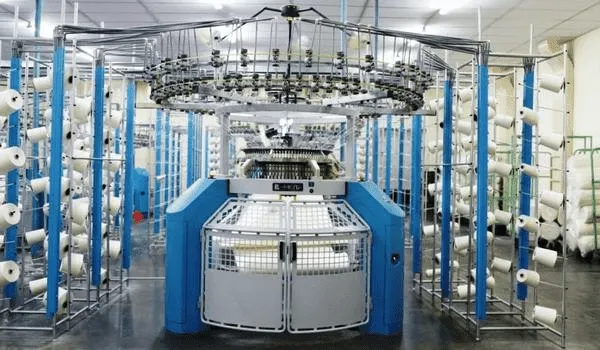
Flow Chart of Knitting Process
The process sequence involved in the textile knitting process is that the yarn is put into the knitting machine creels. After that, the yarn is passed through the knitting machine, where the yarn is converted into knitted greige fabric, and it is wound in a roll. Then the greige fabric is inspected for any faults or defects. After completing the inspection, it’s sent to the next process.
The process chart below has to be maintained during knit fabric manufacturing in the textile:
Yarn in cone package form
↓
Place the yarn package in the creel
↓
Feeding the yarn into the feeder
↓
Set the machine as per the design and GSM
↓
Knitting
↓
Withdraw the rolled fabric and weigh it
↓
Roll making
↓
Inspection
↓
Numbering
↓
Dispatch
Explanation of the Flow Chart of Knitting Process
- Yarn in cone package form: Yarn is supplied in cone form to ensure smooth, continuous feeding during knitting.
- Place the yarn package in the creel: Cones are mounted on the creel so yarn can unwind steadily without tension problems.
- Feeding the yarn in the feeder: Yarn is guided through feeders to control tension and deliver it evenly to the needles.
- Set the machine as per design and GSM: Machine settings are adjusted according to fabric design, structure, and required GSM.
- Knitting: Needles interloop the yarn to form the knitted fabric structure.
- Withdraw the rolled fabric and weigh it: Finished fabric is taken off the machine and weighed to check production and GSM.
- Roll making: Fabric is wound neatly into rolls for easy handling and storage.
- Inspection: Fabric is checked for knitting faults, defects, and quality issues.
- Numbering: Each fabric roll is labeled with identification details for tracking.
- Dispatch: Approved fabric rolls are packed and sent to the next process or customer.