
How to Start a Clothing Business with Less Than $1,000?
Starting a clothing brand has always been a smart business idea. As long as you have fresh and innovative designs in mind, which you feel would set you apart from contemporaries out there, you should be confident in having your clothing business. What makes this business idea difficult is having a tight budget, which limits your capabilities as a business prospect. From design conception, materials, to mass production, development costs will accumulate, and these factors will eventually take their toll on your clothing line. This article details how to start a Clothing Business with Less Than $1,000.
When you start a clothing business with a limited budget, you have to be conscious of the different cost actors involved in garment manufacturing. You cannot be complacent in spending your money, or else you’d end up spending your money on unimportant aspects. In this article, we will discuss how to start a Clothing Business with less than $1,000 by focusing on the things that truly matter so that you stay within your budget.
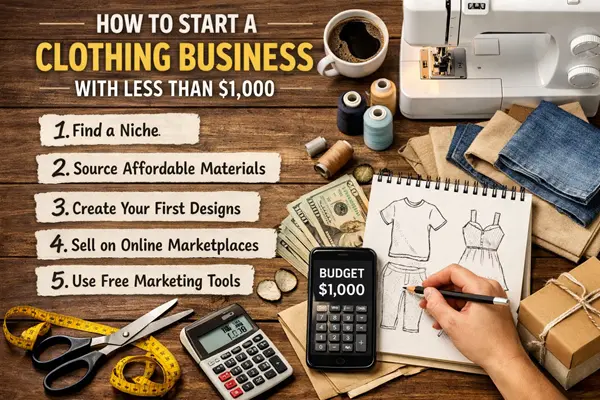
Start a Successful Clothing Business
An ideal textile or clothing manufacturing factory is one that can consistently produce high-quality products at higher productivity and competitively lower cost and thus achieves organizational effectiveness through consistent customer satisfaction, employee empowerment, and social responsibility.
Besides, how to start a Clothing Business under mismanagement may rob of your peace and happiness. You may be under continuous threat of order cancellation, rejection of goods ready at the store, discount, air shipment, so on and so forth. The ownership of an apparel manufacturing factory may prove to be a nightmare.
Have you ever thought that you might control all these ominous factors? Definitely, you will be able to overcome all the crises lest you determine the most critical factors you need to eradicate & the most important processes and systems you need to launch.
What are the Strategic Management Process in the Clothing Business Industry?
A running textile and apparel manufacturing factory must do & not do the following things to circumvent problems & challenges and fetch success.
1. Do you deliver the monthly salary within the first week of the month?
If not, immediately launch a program to deliver salary within the first week of the month.
2. Do you deliver the overtime on legally mandated date?
If not, please launch a program immediately to deliver overtime within the legally mandated date.
3. Do you recruit personnel & staff based on kinship or references?
Immediately launch a program to recruit manpower based on education, training, experience, personal qualities etc. and not on kinship. Appointment based on kinship would do more harm to your management than benefit.
4. Do you have relatives in the management?
If yes, arrange for their training on related topics.
5. Do you train your manpower?
If not, start training your officers & staff on computer literacy & on relevant subjects they are engaged in. Training quickly improves the efficiency and performance of personnel.
6. Do you train your workers and helpers?
Conduct continuous training of your workers so as to make them skilled. Arrange for multi-skilling them. Skilled workers bring your product quality and productivity.
7. Have you installed an internal audit of all aspects of factory operations?
Immediately install an internal audit system to monitor production operation system, quality management system, compliance, and accounts etc.
8. Have you computerized your office work?
- Immediately, computerize the salary delivery system and the accounting system.
- Computerize the material sourcing system and system production and shipment planning.
- Computerized tracking of work from order sourcing up to goods delivery.
- Computerize disciplinary procedures.
- Computerize the making of a packing list of goods to be delivered.
9. Have you installed ISO 9000.2000?
If the answer is “No”, immediately install the system as its gears your facility to better management, higher quality and right documentation.
10. Have you installed the work study method in your production lines?
Immediately install the system as it gears your facility to higher productivity, analysis of the actual situation and finding out problems and bottlenecks so that they may be eliminated. It is the most important for boosting productivity.
11. Have you made your facility safe against fire and accidents?
- Make your factory foolproof against the occurrence of fire.
- Install fire extinguisher, fire hoses, smoke detectors etc. in adequate numbers as mandated by law and requirements.
- Install fire alarms and public address system to use them in case of hazards; conduct regular fire drills and document them.
- Install emergency light in the floor and alarm the stairs or exits.
- Make the machinery equips with eye guard, needle guard, pulley cover etc.
- Train worker to use masks, head scarfs, personal protective equipment (PTE) etc.
12. Do you have male workers in significant numbers?
Make plans to train male workers and replace them with females. If you don’t do it, you may have to face sudden workers explosions, because male temperament does not fully fit to the work culture in the apparel manufacturing industry. Train helper girls to gradually replace male workers. This is not difficult as there is always significant worker turnover in the industry.
13. Have you placed complain & suggestion boxes in your facility?
If “no”, place complain & suggestion boxes in your facility so that workers can ventilate their grievances and suggestions. The management can also understand worker and employee feelings and temperament ahead of time to forestall any hesitation. Clearly mention the person responsible to open the suggestions and complain boxes with designated day and time of opening the boxes.
14. Is your factory capable of sourcing materials on time so that production does not suffer?
If “no”, please introduce quick response merchandising and supply chain management so that you can source all the materials on time so that you can deliver goods on designated date.
15. Is your factory a compliant one?
If “no”, put your factory on compliance mode. Introduce WRAP or SA-8000 codes. Also, introduce ISO 14000. Compliance steers your facility to an ideal factory.
How to Start a Clothing Business with Less Than $1,000: Key Steps Explained
These are the key steps on how to start a Clothing Business with Less Than $1,000:
1. Design Concept:
The design or concept serves as the backbone of your clothing line. This is the first step your budget should be allotted to. If you happen to have graphic design skills or know-how to draw by hand, then you can do the sketch/illustration yourself and save up on graphic design expenses. Hiring professional graphic designers can be costly. Taking advantage of freelance graphic designers (like on Fiverr) is the way to go as you can save up on professional fees while usually getting sufficient quality.
You just have to get your idea across; a design sketch doesn’t have to be a masterpiece. Come up with a design that is relevant to the brand you’re trying to establish. Keep in mind your initial design will be the basis for your future designs. You don’t want to release designs that are far off from each other as it can confuse consumers and will be detrimental to your branding purpose. Create a design that caters to your target market so you can build a niche in which your clothing line belongs. Overall, the cost here is minimal or even zero.
2. Tech Pack:
In the world of clothing manufacturing, a tech pack is a professional design production file in which your clothing will be fully specified. The tech pack includes info such as materials, colors, and other specifications needed for your clothing product. Furthermore, it’s also the basis for preparing a cut sheet which is yet another production file containing the sizes and respective dimensions for each part of your clothes. The tech pack and the cut sheet will serve as the guide for the manufacturers once your product is ready for sampling or mass production. When it comes to tech packs, you probably need some professional help.
Some experience is needed to assess which materials make sense, how the sizing of your clothes should be, and what stitching to use. Otherwise, you might end up with a tech pack that contains a design that is impossible to stitch together or doesn’t turn out as you want to. Also, a certain format has to be followed so that the factory understands what to do. The cost of getting an individual tech pack made varies widely. You can already get a professional tech pack from USD50 (see reference at the end of this article) or commonly spend something between USD200 and USD400.
3. Sample Your Product:
With your tech pack and cut sheet completed, you are now ready to sample your clothing product. The sampling process is a crucial part of the manufacturing process since this will be the trial phase for your initial clothing concept. Expect to discover some errors or room for improvement along the way, and do not hesitate to ask for a revision until the desired specifications are reached. The final sample is the prototype of the clothing product which you will release in the market.
With a good manufacturer, you will also get to get the approximate costing for your clothing product and eventually do the calculations for your estimated margin, assuming different sales prices. Since you are on a tight budget, it is advisable to work hand in hand with the manufacturer to keep errors at a minimum and avoid lots of revisions. Each revision accumulates costs that may offset your budget in case the revisions become too many. The sample and costing process is a lot of work so that the costs are more substantial here. It is possible to get a custom sample plus costing done for USD300 (see reference at the end of this article), while you’re often charged significantly more. Make sure to check for good offers.
4. Starting Mass Production:
After the perfect sample has been created, you can now gear up and integrate the design for mass production. The most difficult problem when working with a limited budget is that you have to find a manufacturer that supports low-volume apparel production, since you have to finance your later larger orders with a few smaller orders first. By working with the specialized small quantity clothing manufacturers, you can realize that without having to pay a fortune per piece.
It is advisable for you to at least check the first production batch as part of your quality control program. Make sure each clothing unit is perfectly created the same way it was during the final sampling. In case you find some substandard products, inform the manufacturer to improve next time or to fix the issue if it’s a bigger problem. The mass production costs depend almost entirely on your product; however, even sophisticated pieces can be made for less than USD10 per piece, even in small quantities. This leaves us with room for doing about 60 pieces of custom clothing, assuming a budget of USD1,000!
5. Market the Clothing Line:
With less than $1000, you can’t allow much money for your marketing campaign since it is now mostly spent on overhead costs, the design and manufacturing expenses. Fortunately, you have social media and your contacts where you can easily market your brand without having to spend a single penny. Create a website and social media channels for your brand, and do most of the marketing here almost for free.
You can also try connecting with fellow young clothing businesses and help each other out through mutual referrals. Do not consider them as direct competitors, especially if you are confident enough that your designs are unique and cater specifically to a target audience. Their customers can also be your potential customers and yet maintain a friendly and healthy competition between design ideas.
There is always a Solution even with a Limited Budget
$1000 is an absolute realistic amount to start your clothing brand. The capital could go a long way with the right knowledge and by working with the right partners for your clothing business. As long as you know your designs will sell, your limited budget should not stop you from pursuing your clothing business goals. In the digital age, leveraging the power of image to video transformation in advertisements not only enhances a brand’s corporate image but also serves as a dynamic tool to foster goodwill and initiate negotiations with retailers.
Conclusion
How to Start a Clothing Business with Less Than $1,000? Starting a clothing business with a very limited budget is not merely a matter of money-saving; it is an opportunity to bring out-of-the-box thinking, to prove the demand, and to create a brand that is not only sustainable but also grows together with its community. Instead of considering your initial $1,000 a bet on a huge stock, see it as the starting capital to demonstrate your idea, meet your very first users, and sponsor your rise.
Don’t sit back and wait for the right time or for a larger budget. Go ahead and design, invite discussions, and create. Your brand is starting now.