
What is an Industrial Overlock Sewing Machine?
Overlock stitching was invented by Merrow Machine Company in 1881. J. Makens Merrow and his son Joseph Merrow had a knitting factory in 1838 where they tried various technological developments to facilitate their company operation. And the result is, for the first time, Merrow’s developed a sewing machine for crochet stitching. It should be noted here that, the Merrow’s machine company still produces crochet stitching machines based on this model. Crochet the stitching machine helps to develop overlock stitching which finally comes as true in 1989, where Joseph Merrow invented over the lock sewing machine. In this article, we are discussing on Industrial Overlock Sewing Machine.
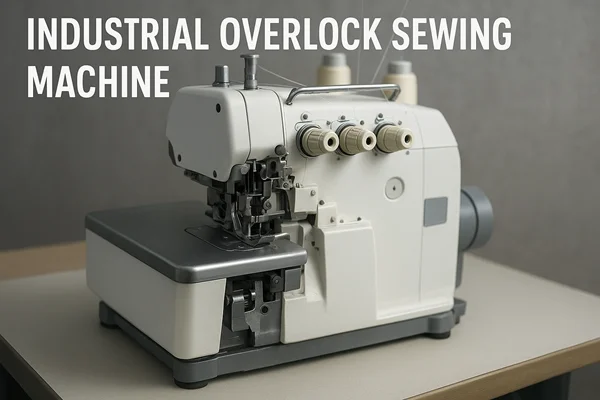
What is an Industrial Overlock Sewing Machine?
An industrial overlock machine is a heavy-duty, high-speed sewing machine specifically designed to perform overlocking stitches in a production environment. Built for continuous operation, often 24/7, it is characterized by its durability, incredible speed (typically 5,000 to 9,000 stitches per minute), and specialized components like a differential feed and knife mechanism.
An industrial overlocker sewing machine, which is commonly referred to as a serging machine, is a very quick and robust device that is capable of stitching, cutting, and finishing the fabric edges all at once. It offers neat and secure seam finishes that stop fraying, gives extra elasticity in the right spots, and encases the garment edges like a pro, but at a much faster rate than a home machine would do. Such machines are extensively used in garment manufacturing, fabric covering, and in any production places where the factors of speed, strength, and uniformity in seam quality are of utmost importance.
Common stitch types of Overlock Sewing Machine and what they’re for:
- 3-thread overlock — basic finishing on woven fabrics; trims and binds an edge with a single needle and two loopers. Lighter, less bulky.
- 4-thread overlock — adds a straight safety stitch combined with an overedge; stronger, used for seams on stretch garments and workwear.
- 5-thread safety stitch — essentially a chain-stitch + overlock for highly durable seams (common in mass-produced garments).
- Rolled hem (narrow hem) — tiny, neat hem for scarves, lightweight garments, and lingerie. Often done by tucking fabric and using a very narrow stitch.
- Flatlock — joins two fabric edges flat (decorative seams on activewear, swimwear) or creates faux seams with minimal bulk.
Key Features of Industrial Overlock Sewing Machine:
Industrial Overlock Sewing machine has various types of key features, which are mentioned below:
- One or multiple numbers of needles is used in case of an over a lock sewing machine.
- An overlock sewing machine is used for both knitted and woven fabrics.
- The objects of single sewing thread using in overlock machine are “end to end seaming” for textile finishing.
- Edge trimmer knife is available here in front of the sewing needle.
- Stitch per minute (SPM) varies from 6500 to 8500 in case of an overlock.
- 1-5 numbers of sewing threads are used here.
- The objects of two sewing threads using is “edging and seaming” especially on woven and knit and finishing seam edges.
- The purposes of three sewing threads using are sewing pintucks and creating narrow rolled hems.
- The objects of four sewing threads using are decorative edging and finishing, also seaming high-stress areas.
- The main key point of five sewing threads using is to make safety stitches by using two sewing needles creating a very strong seam.
- In the case of an over a lock sewing machine, the maximum stitch length is four mm. but it can easily be adjusted by using a push-button system.
Different Parts of Overlock Sewing Machine:
Unlike the Basic Parts of a Sewing Machine for general use, the overlock sewing machine has some other parts. In the apparel manufacturing industry, an overlock sewing m/c consists of the following parts:
- Adjusting screw,
- Oil cap,
- Thread guide,
- Thread tension spring,
- Eye guard,
- Model plate,
- Push-button,
- Cylinder cover,
- Presser’s arm,
- Presser foot release,
- Differential lever,
- Tape Guide,
- Belt cover,
- Oil sight gauge,
- Front cover,
- Indicate lamp,
- Metering devices,
- Roller,
- Presser footer.