
Quality Control of Color Assessment Cabinet in Textile Industry
The color Assessment Cabinet is being used in the Textile Industry for Color matching, all types of color evaluation, and assessment. To ensure consistent and accurate color evaluation under standardized lighting conditions throughout all production processes of the textile and apparel industry. It is applicable for QA, QC, Lab Technicians, and all concerned personnel involved in shade approval and color matching. In this article, we are explaining the Quality Control of the Color Assessment Cabinet in the Textile Industry.
To ensure the proper use and maintenance of textile light boxes for standardized visual color assessments, guaranteeing consistency in light source, viewing conditions, and sample presentation. Applicable to all lab-inspection personnel, performing color assessment, shade matching, and quality control at Falgun Garmenting. Detailed Quality Control of the Color Assessment Cabinet in the Textile Industry is discussed in the following.
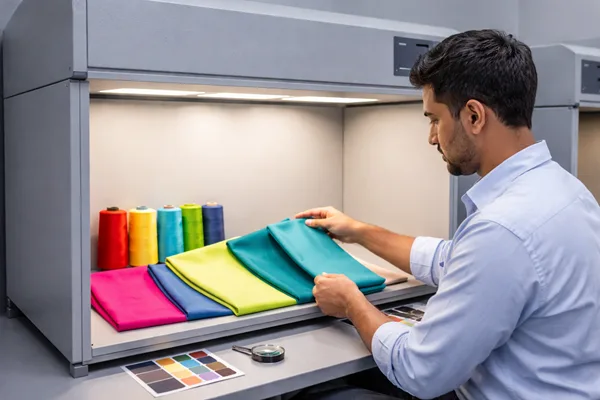
Standard Light Sources in Color Assessment Cabinet Light Box
- D65: Daylight – 6500K for natural light
- TL84/83: Fluorescent light – store condition (EU/Asia)
- CWF: Cool White Fluorescent – store condition (USA)
- A: Incandescent light – home condition
- UV: Ultraviolet light – to detect optical brighteners
- U30/F: Warm light – retail lighting in US
Purpose of Each Light Source
- D65: Primary evaluation of color under natural daylight conditions. Practical Example: Matching bulk garment color with approved shade during final inspection.
- TL84: Simulates store lighting in Europe/Asia; used for retail color evaluation. Practical Example: Checking how garment color appears in showroom or store display lighting.
- CWF: Simulates US retail environment (office/store); ensures international compliance. Practical Example: Evaluating fabric shade for garments to be shipped to US market.
- A: Home lighting (incandescent); checks how color looks in warm light. Practical Example: Ensuring consumer perception under household lighting like bulbs or lamps.
- UV: Detects presence of optical brightening agents (OBA) or fluorescent dyes. Practical Example: Identifying if white garments glow under UV, indicating presence of brighteners.
- U30/F: US retail display (warm light); alternative to TL84 for certain buyers. Practical Example: Used when buyer specifically requires warm-tone retail lighting for final checks.
Color Evaluation Procedure:
- Turn on the Light Box and select D65 light first.
- Place the garment/fabric at a 45-degree angle inside the cabinet.
- Compare with the counter/master sample.
- Switch to TL84, A, and UV sequentially.
- Check for metamerism (shade change under different lights).
- Record results in the logbook.
Responsibilities of Different Functions for Quality Control of the Color Assessment Cabinet
Lab Technician: Operate the textile light box and perform visual assessments as per procedure. Ensure proper documentation of observations and maintenance activities. Maintain cleanliness and
functionality of the light box.
Target: Achieve 100% accuracy in documenting observations during color assessments and maintain the light box in operational condition at all times. Ensure all samples and standards are inspected under designated light sources without deviation.
QA Manager: Oversee compliance with buyer-specific requirements and internal standards. Review and approve Light Box Operational Overview reports for audit purposes. Address discrepancies in assessments
promptly and ensure corrective actions.
Target: Verify and approve at least 95% of Light Box Operational Overview reports within 48 hours of submission. Ensure zero instances of noncompliance with buyer-specific light source requirements during audits
Quality In-Charge: Ensure proper training for lab technicians on the use of the textile light box. Conduct periodic checks to verify the accuracy and consistency of visual assessments. Coordinate with maintenance staff to ensure timely replacement of light sources and box upkeep.
Target: Conduct periodic training for all lab technicians at least twice a year, ensuring a 100% knowledge update. Complete a minimum of 95% of scheduled checks on lab operations and report findings monthly to the QA Manager.
Maintenance Team: Perform scheduled maintenance, including cleaning, light tube replacement, and interior repainting. Maintain the service log, documenting repairs, calibrations, and replacements.
Target: Achieve 100% adherence to the light tube replacement and box servicing schedules as outlined in the SOP. Ensure that any reported issues are resolved within 24 hours to maintain uninterrupted operations.
Conlcusion
The standardized artificial daylight is used for visual color assessments and shade matching in textile and fabric quality control. The Color Assessment Cabinet has a color temperature of 6500K and simulates natural daylight conditions. D65 is the most important light source for accurate color matching.
The UV light source emits ultraviolet rays and is used to detect the presence of optical brightening agents (OBAs) and fluorescent dyes, particularly in white fabrics. It helps identify fluorescence effects that are not visible under standard lighting.
- You may love to read: Pantone Color Guide & Its Application in the Textile and Apparel Industry