Color is often the first thing a customer notices and one of the most common reasons for rejected goods. To make sure a buyer in one country and a dyehouse in another mean the same color, the textile industry needs a shared color language. The most widely used one is the Pantone system.
This guide explains how Pantone colors are specified for textiles and how they are used in lab dips, approvals and bulk production. Pantone is a trademark of Pantone LLC; this article describes how the system is used in practice and does not reproduce its color data.
Two Pantone systems: graphics and textiles#
| System | Used for | Example code |
|---|---|---|
| Pantone Matching System (PMS) | Printing, packaging, labels, hangtags | A number with a C (coated) or U (uncoated) suffix |
| Pantone Fashion, Home + Interiors (FHI) | Textiles, apparel, home furnishings | 19-4052 TCX |
The PMS system is built on ink on paper, so it is used for trims printed on paper or board such as hangtags, and sometimes for printed labels. For fabric and yarn, the FHI system is used, because a color printed on paper and the same color dyed on cotton do not look identical.
How to read a textile code#
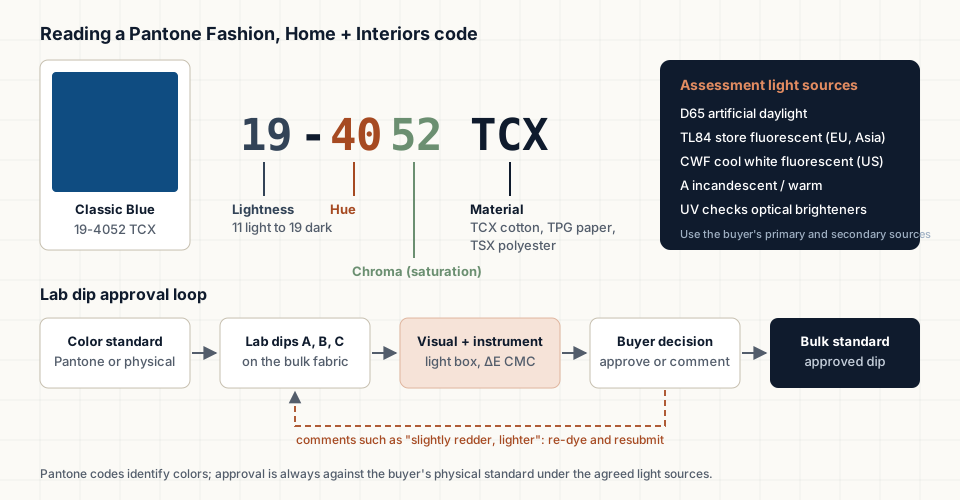
A code such as 19-4052 TCX (Classic Blue, Pantone's Color of the Year for 2020) has four parts:
| Part | Meaning |
|---|---|
| 19 | Lightness, from 11 (lightest) to 19 (darkest) |
| 40 | Hue family (position around the color wheel) |
| 52 | Chroma, or saturation (how strong the color is) |
| TCX | The material of the physical standard |
Common material suffixes:
- TCX: dyed cotton swatches, the most used textile standard.
- TPG: printed on paper, used in color books and for quick reference.
- TSX: dyed polyester swatches, for synthetic fabrics.
A TCX swatch and the TPG version of the same color can look slightly different. When the buyer names a TCX color, work from the cotton swatch, not the paper page.
Recent Colors of the Year#
Pantone announces a Color of the Year each December, and it influences product development in many brands:
| Year | Color | Code |
|---|---|---|
| 2020 | Classic Blue | 19-4052 |
| 2023 | Viva Magenta | 18-1750 |
| 2024 | Peach Fuzz | 13-1023 |
| 2025 | Mocha Mousse | 17-1230 |
Pantone also publishes seasonal color trend reports around the major fashion weeks. These guide design direction; they do not replace the buyer's color standard for an order.
From Pantone code to approved color: the lab dip process#
A lab dip is a small fabric or yarn sample dyed in the laboratory to match the buyer's color standard. It is the first step in turning a color reference into production.
- Receive the color standard: a Pantone TCX reference, a buyer's own physical standard, or a previous approved dip. Confirm the light sources and tolerance the buyer uses.
- Prepare lab dips on the same fabric quality as bulk, after the same pretreatment. Most dyehouses submit two or three options, labelled A, B and C, each slightly different.
- Check internally under the buyer's light sources in a light box, and with a spectrophotometer where available.
- Submit the dips on a lab dip card with the reference, fabric, dye class and recipe number.
- Buyer decision: approved, or rejected with comments such as "slightly redder, lighter". Re-dye and resubmit if needed.
- Approved dip becomes the bulk standard. Keep a portion safely, away from light, for bulk shade approval.
Lab dip approval is usually on the critical path of the order, because fabric production cannot start until colors are approved. Plan it in the time and action plan and track the first-submission approval rate as a right first time measure.
Assessing color: light sources#
A color that matches under one light can differ under another. Buyers therefore define a primary light source and one or more secondary sources.
| Light source | Represents | Typical use |
|---|---|---|
| D65 | Average daylight | Primary source for many buyers |
| TL84 | Store fluorescent lighting common in Europe and Asia | Common secondary source |
| CWF | Cool white fluorescent common in the USA | Secondary source for many US buyers |
| A (incandescent) | Warm tungsten light | Checks metamerism under warm light |
| UV | Ultraviolet | Checks optical brightening agents in whites |
Assess in a standard light booth with a neutral grey interior, with samples side by side, at the same angle and orientation.
Metamerism#
Metamerism is when two samples match under one light source but not under another. It happens when the standard and the sample are colored with different dyes or pigments. A dip that matches in D65 but looks redder in TL84 will be rejected by a buyer who checks both. Choose dyes that give a close spectral match to the standard, not only a visual match under one light.
Measuring color with instruments#
A spectrophotometer measures how much light a sample reflects at each wavelength. Software converts this into color coordinates, usually CIELAB:
- L*: lightness (0 black, 100 white).
- a*: red (positive) to green (negative).
- b*: yellow (positive) to blue (negative).
The difference between the standard and the sample is expressed as a single number, Delta E (ΔE). Several formulas exist:
| Formula | Notes |
|---|---|
| ΔE*ab (CIELAB 1976) | Simple distance in CIELAB space; not uniform to the eye |
| ΔE CMC (l) | Weighted formula used widely in textiles, commonly CMC 2 |
| ΔE 2000 (CIEDE2000) | Newer weighted formula used by many brands |
The buyer sets the formula and the tolerance. A frequently used acceptance level is around 1.0 ΔE CMC(2), but tolerances vary by buyer, color and product, so always use the buyer's figure. Instrument results support visual assessment; they do not replace it unless the buyer approves instrumental pass or fail.
Bulk production and shade control#
After the lab dip is approved, bulk dyeing must match it lot after lot:
- Bulk shade approval: the first bulk lot is submitted against the approved dip.
- Shade bands and continuity cards: cuttings from each dye lot, arranged to show shade groups.
- Shade grouping at cutting: rolls are grouped by shade and never mixed in a garment. See shade variation.
- Trims: threads, zippers, rib and labels must be matched to the approved color too, and listed in the bill of materials with their color references.
Critical color points should be confirmed in the pre-production meeting, with approved dips and trim cards available at the meeting.
Color matching versus color fastness#
A perfect match is worthless if the color fades or bleeds. Approval covers the shade; testing covers the durability of the color. See color fastness and color fastness to washing. Deep, bright shades often need a different dye selection to meet both the shade and the fastness requirements.
Fabric affects color#
The same dye recipe looks different on different fabrics. Surface texture, luster, fiber and construction all change how color is seen. A color on smooth polyester satin can look brighter and cleaner than on cotton jersey, and a TCX cotton swatch cannot be matched exactly on every fiber. Agree with the buyer which differences are acceptable when the bulk fabric is very different from the standard's material. The main fabric types and their characters are described in different types of fabric for dresses and clothing.
Common mistakes in color approval#
- Matching to a paper (TPG) page when the buyer specified a TCX cotton standard.
- Using old or faded standards. Physical swatches change with light, handling and time. Store them closed, away from light, and replace them as the supplier recommends.
- Checking under the wrong light source, or in daylight near a window.
- Making lab dips on a different fabric from bulk.
- Ignoring metamerism by approving under one light only.
- Not controlling trims: a perfectly matched body with an off-shade rib or zipper still fails.
Frequently asked questions#
What does TCX mean in Pantone codes? TCX refers to the cotton edition of the Pantone Fashion, Home + Interiors color standards: colors dyed on cotton fabric.
Can I use a phone screen to judge a Pantone color? No. Screens and printed pictures are not reliable references. Use the physical standard in a light booth.
Why are there three lab dip options? Giving the buyer small variations (for example slightly lighter or redder) often lets them approve one in the first round, which saves time.
Is a Pantone code enough to specify a color? It identifies the target color, but the buyer should also state the light sources, the tolerance and whether an approved lab dip becomes the bulk standard.