List of Trims and Accessories Used in Garments Industry
The term Trims and Accessories mainly applies to sewing, pressing, folding, and packing of garments. After completing pressing, the garments have to be folded and then packed. To complete all tasks, trims used in the sewing process and accessories are called garment finishing accessories. Various kinds of garment finishing accessories are used in the garment finishing process. In a previous article, I discussed a list of Trims and Accessories Used in the garment industry.
List of Trims and Accessories used in the Garments Industry
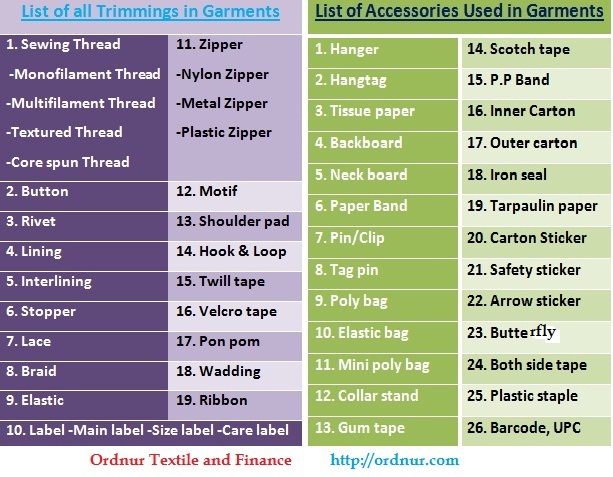
The items and processes to be discussed in this article are those components, other than the primary fabric of the garment, that are an essential part of the construction of the garment or that act as trimming. List of Trims and Accessories Used in the Garments Industry is mentioned below:
List of All Trims in Garments
- Sewing thread
- Button
- interlinings
- Zipper
- Elastic
- lining
- Label
- Motif
- Less
- Pocketing fabric
- Ribbon
- Collar bone
- Rivet
- Hook and loop fastenings
- Wadding
- Braid
Sewing thread:
Sewing thread is the most important trimming used in the garment industry. Almost all garments produced have one element in common: the stitching thread. Whilst stitching thread is most notably a small percentage of the cost of garments.
Button:
Buttons are hardware gadgets used together with buttonholes for the fastening of garments. They can upload decoration in addition to providing a closure; buttons can be used on my own as decoration. The sort of materials from which buttons can be made is Considerable, including herbal wood, bone, man-made metal, polyester, and casein. In addition, Plastic and metal can be combined, which include while a metal ring encircling a button, and plastic may be protected with the fabric of the garment.
Zipper:
These are the principal gadgets used in clothing that are partly textiles in nature and in part non-textile, difficult material. They offer a neat, robust fastening in garments Zipper is used device for binding the rims of an opening of fabric or other flexible material, Zip used in apparel jackets and jeans, bags, and different bags.
Lace:
The term lace correctly refers to the type of open shape originally made with the aid of hand and now available in a variety of machine-made forms. Some are formed from twisted yarns, few are embroideries on the net or more solid fabric.
Motif:
The term motif is frequently used to describe a decorative addition to the garment, but the use of motifs sporting a company’s name, trademark or brand is now widespread. Consequently, the subject of labels and the subject of motifs can’t be separated easily. Motifs are available in a wide form of types, sizes, and methods of attachment but the range could be limited here to small, decorative objects that are attached flat to the outside of cloth.
Elastic:
Where elasticated effects are required regionally on garments but without added decoration, corded elastic of diverse widths or even flat rubber strips are used. Corded elastics incorporate rubber or elastin threads, which provide excessive stretch and recovery.
Level:
No garment may be sold without some kind of label attached to it. Labeling listing fiber content is mandatory; size labeling is clearly necessary. Care labeling is usually voluntary in place of a legal requirement; however, its use is on the increases retailers try to make sure that clothes do not fail the consumer as a result of incorrect action.
Lining:
Linings are usually a functional part of the cloth, being used variously to maintain the shape of the cloth, to enhance the hang and comfort by allowing it to slide over different fabrics, to add insulation, and to cover the inside of a garment of complicated production to make it neat. In many cases, linings are chosen to match the garment to be able to be unobtrusive; however, in others, they are chosen to add to the design of the garment, even perhaps as a subtle, identifying feature of the brand on an otherwise widely available style.
Interlinings:
Interlinings are used to support, toughen, and control areas of garments, including collars, cuffs, waistbands, hems, facings, and the fronts of jackets and coats. They can be sewn into the garment or attached by using fusing. The complexity of the interlinings used varies greatly between
tailored wear, in particular, menswear, and other varieties of garments.
Hook and Loop fastenings:
Hook and loop fastening is utilized in a restricted range of garment applications; however, where it’s used more frequently, its particular properties are extraordinarily valuable. The advantage in this context is that it is able to be opened and closed easily, even when wearing gloves or mittens, and it is useful to provide a secondary, moderately water-resistant closure over zips on such garments.
Wadding:
Wadding is the name given to the fiber fillings used in garments where warmth is required without remarkable weight. They aim to simulate the warm temperature and lightness of down, but with the advantage of washability and speed of drying, as well as decreasing cost. The fiber used most typically is polyester.
Braid:
Braids were originally braided fabrics, produced by way of interlacing yarns diagonally in a shape of plaiting. They were either slender flat fabrics or the sort of slender tube familiar as shoelaces. Flat braids of this type are still used, and in wool and acrylic, they make tender and flexible edgings for binding round medium and heavyweight garments.
List of Accessories Used in Garments
- Hang tag
- Price tag
- Plastic/ poly bag
- Tissue paper
- Carton
- Scotch tape
- PP belt
- Tag pin
- Plastic clip
- Sticker
- Butterfly
- Collar insert
- Back board
- Necks insert
1. Hang tag: Hang tags hanging on the top of products.
2. Price tag: A label showing the price of an item for sale.
3. Plastic/ poly bag: A polythene bag used for the storage or packaging of a product.
4. Tissue paper: Thin, soft paper, typically used for wrapping or protecting fragile or delicate articles.
5. Carton: A small, light box or container in which drinks or foodstuffs are packaged.
6. Scotch tape: Transparent adhesive tape.
7. PP belt: A flexible band, as of leather or cloth, worn around the waist to support clothing, secure tools or weapons, or serve as decoration.
8. Tag pin: Tag pins help tag price cards to products, using tag guns. We produce a variety of tag pins and tag guns to suit every market and need.
9. Plastic clip: A plastic clip for holding sheets of paper together, holding a hang tag, or other things.
10. Sticker: An adhesive label or notice generally printed or illustrated.
11. Butterfly: A decorative fabric bow traditionally sewn onto the back of a formal suit jacket.
12. Collar insert: A thin, rigid strip placed inside a collar’s points to maintain their crisp, sharp shape.
13. Backboard: A board placed under or behind something or someone to provide firmness or support.
14. Neck Inserts: A supportive strip of fabric or interfacing sewn into a shirt’s neckline seam to prevent stretching and retain shape.
Apart from the main materials, fabrics, these are the List of Trims and Accessories Used in the Garments Industry to complete as finished garments.