Moisture is one of the most expensive hidden risks in garment export. Cartons packed with damp garments, sealed in a container and shipped through hot and cold climates can arrive with mold, odor, staining and damaged cartons. The result is claims, rejected shipments and lost customers, even when every garment passed inspection in the factory.
Mold needs moisture, warmth and time. A factory cannot control the voyage, but it can make sure garments and cartons leave dry. This article sets out the principles and a standard operating procedure (SOP) that can be adapted to your factory and your buyers' requirements.
Why moisture control matters#
- Mold and mildew grow on cellulosic fibers (cotton, viscose, linen) and on cartons when moisture and humidity stay high.
- Odor: musty smells cannot always be removed by washing.
- Stains and discoloration, including yellowing and marks from wet carton dyes.
- Carton failure: damp corrugated board loses strength, cartons collapse in stacks.
- Container condensation: moisture from damp goods evaporates in the warm container and condenses on the ceiling as temperatures fall, then drips back onto the cartons.
Key terms#
Moisture content and moisture regain#
Two ways of expressing how much water a material holds:
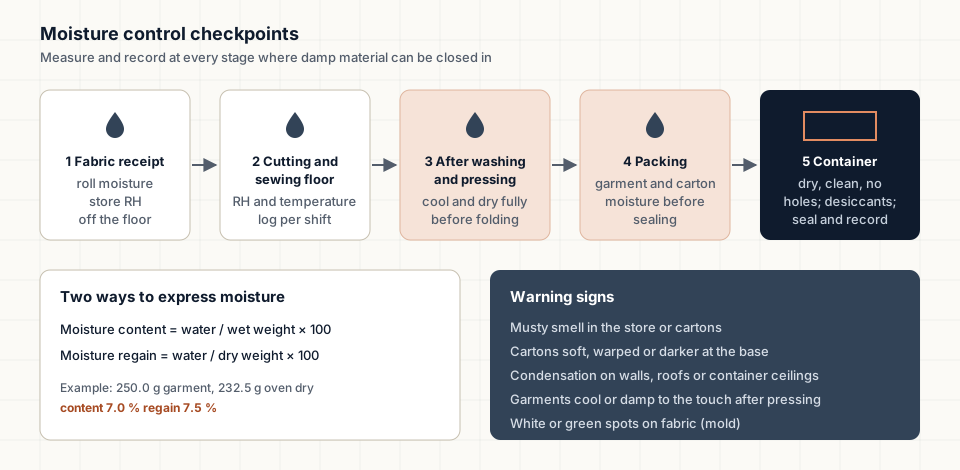
Example: a garment weighs 250.0 g as received and 232.5 g after oven drying. The water is 17.5 g.
- Moisture content = 17.5 / 250.0 × 100 = 7.0%
- Moisture regain = 17.5 / 232.5 × 100 = 7.5%
Always state which one you mean. Handheld textile moisture meters usually display moisture content, calibrated for a material type.
Relative humidity (RH)#
RH is how much water vapour the air holds compared with the maximum at that temperature. Textiles take up or give off moisture until they balance with the air around them. Cotton's standard moisture regain is commonly quoted at about 8.5% in the standard testing atmosphere (20 °C, 65% RH), so cotton garments stored in very humid air hold more water than that.
Mold risk rises sharply when the relative humidity of the air around goods stays high, commonly cited as above about 65 to 70%, for extended periods.
Buyer limits#
Many buyers set maximum moisture content limits for garments and cartons at packing, and require moisture records and anti-mold measures. Limits differ by buyer, fiber and product. Use the buyer's limit. If there is none, set an internal limit with your quality team, based on the fiber, your climate and the shipping route, and apply it consistently.
Standard operating procedure#
1. Purpose#
To prevent mold, odor and moisture damage by controlling the moisture of materials, garments and packing materials from receipt to shipment.
2. Scope#
Fabric and trims stores, cutting, sewing, washing, finishing, packing, finished goods store and container loading.
3. Responsibilities#
| Role | Responsibility |
|---|---|
| Quality manager | Owns the SOP, sets limits, reviews records weekly |
| Store in-charge | Store conditions, fabric and carton moisture checks at receipt |
| Finishing and packing supervisor | Garment and carton moisture checks before sealing |
| Quality auditors | Random verification, container checks |
| Maintenance | Dehumidifiers, ventilation, roof and wall leaks, calibration support |
4. Equipment#
- Calibrated moisture meters for textiles and for cartons (with the right material setting).
- Thermo-hygrometers in stores, finishing, packing and the finished goods store.
- A precision balance and drying oven for reference checks of the meter.
- Dehumidifiers and ventilation fans where the climate requires them.
- Desiccants for cartons or containers where the buyer allows or requires them.
5. Checkpoints and frequency#
| Checkpoint | What to measure | Frequency (example) |
|---|---|---|
| Fabric receipt | Roll moisture (a sample of rolls per lot), condition of roll wrapping | Every lot |
| Stores | RH and temperature | Twice per shift |
| Carton receipt | Carton board moisture, visible damp or warping | Every delivery |
| After washing or wet processing | Garment moisture after drying | Every batch |
| After pressing | Garments cooled and dry before folding | Continuous, spot checks each hour |
| Packing | Garment moisture and carton moisture before sealing | A sample from every carton group, per shift |
| Finished goods store | RH, temperature, cartons off the floor and away from walls | Twice per shift |
| Container loading | Container condition, floor dryness, weather at loading | Every container |
Adjust frequencies to risk: increase checks in the rainy season, for garment-washed products and when readings approach the limit.
6. Measurement method#
- Check the meter against its calibration block or reference at the start of each shift.
- Measure garments on several points (for example body, seams and the thickest part such as waistbands).
- Measure cartons on the inside walls and base.
- Record the highest reading, not only the average.
- For disputes, confirm with the oven-dry method on a sample.
7. Controls#
- Store fabric and cartons off the floor on pallets and away from walls, with space for air to move.
- Keep stores closed and ventilated; use dehumidifiers when RH stays high.
- Dry fully after washing: garments must be dry through thick seams, not only on the surface.
- Cool garments after pressing before folding and bagging, so steam moisture escapes.
- Never pack damp garments or use damp cartons.
- Container checks: no holes or leaks (a light test inside a closed container shows holes), clean and dry floor, no odors; load in dry weather or under cover.
- Anti-mold aids only as approved by the buyer: desiccant packs, container dry bags, anti-mold stickers or papers that meet the buyer's chemical rules. Products containing dimethyl fumarate (DMF) are banned in the European Union; check all anti-mold products against restricted substances lists.
- Good housekeeping: fix roof leaks, clear spills, keep drains working. See 5S in a garment factory.
8. Records#
| Record | Kept by |
|---|---|
| RH and temperature log per area | Store and finishing supervisors |
| Fabric and carton moisture at receipt | Store |
| Garment and carton moisture at packing | Packing supervisor |
| Container inspection checklist | Quality auditor |
| Meter calibration log | Quality |
| Corrective actions | Quality manager |
9. When readings are above the limit#
- Stop packing or shipping the affected goods.
- Isolate and label them.
- Dry garments in a controlled way (drying room, tumble or air flow) and recheck; replace damp cartons.
- Recheck before releasing.
- Find the cause: weather, a leak, incomplete drying, pressing without cooling, damp cartons. Use root cause analysis.
- Record a corrective and preventive action; see CAPA.
Where moisture problems usually start#
| Source | Example |
|---|---|
| Wet processing | Garment-washed jeans packed before thick seams are fully dry |
| Pressing | Steam-pressed garments bagged while still warm and moist |
| Humid climate | Monsoon season with RH near saturation for days |
| Building | Roof leaks, damp floors, condensation on metal roofs |
| Cartons | Cartons delivered damp or stored on the floor |
| Container | Damp floor, holes, loading in rain |
Moisture control in the finishing flow#
Moisture checks fit naturally into the finishing sequence: after pressing, at packing and before the goods enter the finished goods store. The complete sequence and layout are described in process flow chart and layout of garments finishing. Buyers and inspectors increasingly check moisture records during final inspection, so keep the logs at the inspection area.
Frequently asked questions#
Is moisture content the same as moisture regain? No. Content is water as a percentage of wet weight; regain is water as a percentage of dry weight. Regain is always the larger number for the same sample.
Can silica gel prevent mold on its own? Desiccants help absorb moisture in closed spaces, but they cannot dry goods that were packed wet. Dry goods and dry cartons are the real control.
Why do garments that were dry in the factory arrive moldy? Often because cartons or garments held more moisture than was measured, or because condensation formed in the container. Measure the thickest parts, cartons as well as garments, and check the container.
How often should moisture meters be calibrated? Check them daily against their reference and follow the supplier's calibration interval, with periodic comparison against the oven-dry method.