
List of 50 Textile Testing Machines Used in Spinning & Weaving Mill
Today’s readymade apparel business totally depends on quality. Different types of textile testing machines are used in spinning, weaving, knitting, and dyeing factories to ensure the required quality of apparel or clothing. Given its importance, this article has presented a list of the top 50 textile testing machines that are significantly used in spinning and weaving mills.
Good quality yarn produces good Fabric. Testing machines give quality results for Yarn and Fabrics in Weaving and Spinning mills. The customer wants to see the quality results by Textile Testing Machines of their Yarn and Fabric. The test result of Textile Testing Machines gives a Quality certificate to proceed to the next steps. We made a List of 50 Textile Testing Machines Used in Spinning & Weaving mills, and also mentioned their functions.
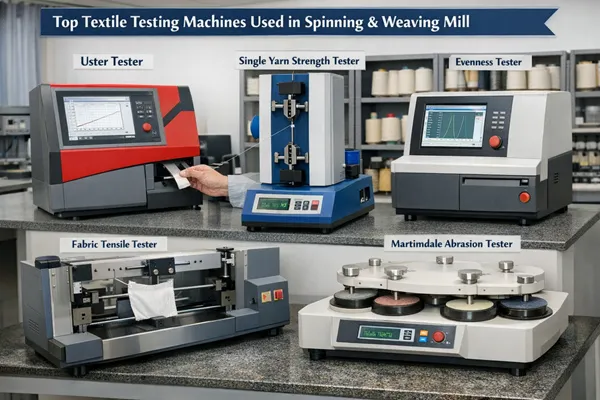
List of Textile Testing Equipment Used in Weaving and Spinning Factory:
All types of testing machinery which are used in spinning and weaving have pointed out the below:
- Drying oven – Removes moisture from textile samples under controlled temperature conditions.
- Yarn appearance board winder – Prepares yarn wraps on boards for visual quality inspection.
- Crimp rigidity tester – Measures the resistance of textured yarns to decrimping.
- Crimp tester – Evaluates the crimp properties and elasticity of textured yarns.
- Zigzag cutter – Cuts fabric samples in a zigzag pattern to prevent fraying during testing.
- Digital fabric thickness gauge – Measures fabric thickness with digital precision.
- Digital pilling tester – Assesses a fabric’s tendency to form pills using digital evaluation.
- Stiffness tester – Determines the bending rigidity and drape of fabrics.
- Water impact penetration tester – Simulates rain to test the fabric’s resistance to water penetration.
- Water repellency tester – Evaluates a fabric’s ability to resist water absorption.
- GSM Cutter – Cuts a precise circular fabric sample for gram per square meter (GSM) measurement.
- Fabric Shrinkage template and scale – Measures dimensional changes in fabrics after washing.
- Hydraulic GSM cutter – Uses hydraulic pressure to cut precise fabric samples for GSM testing.
- Crease recovery tester – Measures a fabric’s ability to recover from creasing.
- Crockmeter – Tests colorfastness to rubbing (dry and wet).
- Lightfastness tester – Exposes materials to light to assess color fading resistance.
- Sublimation fastness tester – Evaluates color transfer due to heat.
- Perspirometer – Tests colorfastness to perspiration.
- Washing fastness tester – Assesses colorfastness to domestic or commercial laundering.
- Stroboscope – Creates an optical illusion to make moving machinery appear stationary for inspection.
- Digital anemometer – Measures air velocity and flow.
- Lux meter – Measures illumination intensity.
- IT thermometer – Monitors temperature in industrial processes.
- Sequence check machine – Verifies the color or pattern sequence in yarns or fabrics.
- Tachometer – Measures the rotational speed of machinery.
- Sound label meter – Measures noise levels in the workplace.
- Moisture meter – Determines the moisture content in materials.
- Cotton moisture meter – Specifically measures moisture content in cotton.
- Package hardness tester – Measures the compression resistance of yarn packages.
- Digital film coating thickness gauge – Measures the thickness of coatings on fabrics or films.
- Digital yarn package hardness tester – Assesses the firmness of yarn packages digitally.
- Digital Thermo hydrometer – Measures temperature and relative humidity.
- Color matching cabinet – Provides standardized lighting for visual color assessment.
- Laboratory drum – Used for small-scale washing, dyeing, or finishing simulations.
- Microscope – Examines fiber, yarn, or fabric structure at high magnification.
- Psychomotor or hygrometer – Measures atmospheric humidity.
- Fiber strength tester – Determines the tensile strength of individual fibers or bundles.
- Roving reel and yarn reel – Winding devices to prepare specified lengths of roving or yarn for testing.
- Direct yarn count balance – Directly measures the linear density (count) of yarn.
- Yarn winding unit for preparing blackboard for yarn appearance – Winds yarn onto boards for evenness and defect inspection.
- Lap meter – Measures the weight per unit length of fiber lap.
- USB digital microscope – Captures and displays magnified images on a computer.
- Various types of balance – Weigh samples with precision for different laboratory applications.
- Twist tester – Measures the number of twists per unit length in yarn.
- Tensile strength tester – Measures the force required to break a fabric, yarn, or fiber.
- Length measurement instrument – Measures the length of fibers, yarns, or fabrics.
- Evenness tester – Assesses the mass or thickness variation along the length of a yarn or sliver.
- Abrasion tester – Evaluates a fabric’s resistance to surface wear from rubbing.
- Fiber fineness and maturity tester – Measures fiber diameter and maturity (for cotton).
- Thickness tester, etc. – Measures the thickness of materials like fabric, paper, or leather.
Auxiliary Testing Equipment Used in Spinning and Weaving Factory:
Those are-
- Pick out needles and combs,
- Steel rulers of different measurements,
- Scissors,
- Stopwatch,
- Small velvet-covered board,
- Magnifying glass,
- Template of different sizes,
- Nep counting board,
- Tweezers,
- Calculator etc.
List of Hygrometers or Psychrometers Used in the Textile Industry:
Some psychrometers or hygrometers, which are normally used in the textile industry, are listed in the following:
- Wet and dry bulb hygrometer,
- Electrolytic hygrometer,
- Hair hygrometer,
- Chemical hygrometer,
- Dew point hygrometer,
- Pantone Color Guide
- Gravimetric hygrometer, etc.
- You may love to read: Fabric Testing Machines List in the Textile Industry