GSM means grams per square meter. It is the mass of one square meter of fabric, and it is the most common way to describe how heavy a fabric is. A 180 GSM single jersey weighs 180 grams for every square meter of cloth.
GSM matters because it connects almost everything in a garment order. Buyers specify it, knitters and weavers build fabric to reach it, dyeing and finishing change it, and merchandisers use it to calculate fabric consumption and cost. When GSM is wrong, the garment can feel wrong, fit wrong, fail testing, or cost more than planned.
The GSM formula#
GSM is simply weight divided by area, with the area converted to square meters:
where:
- is the weight of the sample in grams
- is the area of the sample in square centimeters
- converts square centimeters to square meters (1 m² = 10,000 cm²)
If you measure the sample in square meters, the formula is just .
The 100 cm² shortcut#
Most GSM round cutters cut a circle with an area of exactly 100 cm² (a diameter of about 11.28 cm). For that sample:
So a cut sample that weighs 1.80 g gives 180 GSM. This is why the cutter is so popular: the balance reading multiplied by 100 is the answer.
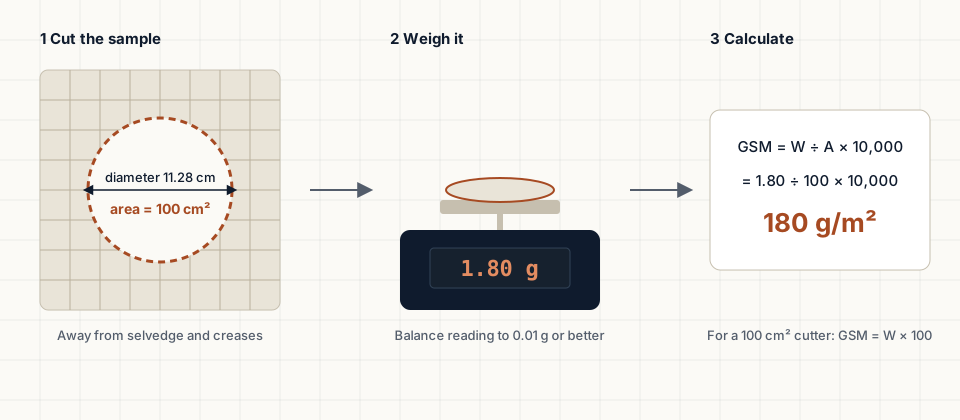
How to measure GSM with a round cutter#
The method below is the everyday factory and laboratory check. Formal testing follows the method named in your specification, such as ISO 3801 or ASTM D3776, which define specimen sizes, conditioning and reporting.
- Condition the fabric. Fabric weight changes with moisture, especially cotton and viscose. Leave the sample flat in a standard atmosphere before testing. The usual laboratory condition is 20 °C and 65% relative humidity, but follow the method your buyer names.
- Choose sample positions. Take samples across the width, at least 10 cm away from the selvedge or the tube fold line. Avoid creases, joins, holes and marked areas.
- Cut cleanly. Place the fabric on the rubber cutting pad without stretching it. Press and rotate the cutter so every yarn is cut, not torn.
- Weigh. Use a balance that reads to at least 0.01 g, and preferably 0.001 g. Remove loose fibers from the sample edge before weighing.
- Repeat and average. Take three to five samples and report the average. Also record the range: a large spread tells you more about the fabric than the average does.
- Calculate. Apply the formula, or multiply by 100 for a 100 cm² cutter.
Worked examples#
The two examples use different sample sizes but the same formula. That is the key point: GSM does not depend on the cutter. The cutter only makes the arithmetic easy.
Estimating GSM before fabric exists#
Sometimes you need a GSM figure before any fabric has been made, for example when planning a new quality or checking a supplier's construction sheet. You can estimate it from construction.
For a woven fabric, the weight comes from the warp yarns and the weft yarns:
EPI and PPI are ends and picks per inch, and are warp and weft crimp as fractions, and and are the yarn counts in tex. The number 39.37 converts threads per inch to threads per meter.
For a single jersey knit, the weight comes from the loop length:
Here CPI and WPI are courses and wales per inch, is the stitch length in millimeters, and is the yarn count in tex. The factor 1550 is the number of square inches in a square meter.
These estimates are useful for planning and for asking the right questions, but they are not a substitute for a cut sample. Finishing, compaction, brushing, resin add-on and moisture all change the real weight. The GSM calculator includes both construction methods, and yarn count conversion explains how to get tex from Ne or denier.
Typical GSM ranges#
The table gives broad ranges seen in apparel fabrics. Buyers set their own targets for each program, so use these only to sense-check a specification.
| Fabric | Typical GSM range | Typical use |
|---|---|---|
| Single jersey, lightweight | 120 to 150 | Summer T-shirts, lining |
| Single jersey, standard | 150 to 200 | Basic T-shirts |
| Pique | 180 to 240 | Polo shirts |
| 1×1 rib | 180 to 260 | Tops, collars, cuffs |
| Interlock | 200 to 280 | Baby wear, tops |
| French terry | 240 to 330 | Sweatshirts, joggers |
| Fleece | 260 to 400 | Hoodies, sweatshirts |
| Poplin (woven) | 100 to 140 | Shirts |
| Denim (woven) | 270 to 470 | Jeans, jackets |
A fuller table, with notes on how composition and finishing shift these numbers, is in the fabric GSM chart. If a specification is written in ounces, use the GSM to oz/yd² conversion.
GSM tolerance#
No fabric is perfectly uniform, so every specification needs a tolerance. The tolerance is agreed between buyer and supplier and written in the fabric specification or the buyer's testing manual. A plus or minus 5% band is common for knits, but you must use the figure that applies to your order.
Two practical points:
- Check both the average and the individual readings. A roll can meet the average and still have a heavy edge and a light centre.
- Agree the fabric state. Grey fabric, finished fabric and fabric after garment wash will all read differently. Write down which one the target refers to.
What changes GSM in production#
When GSM drifts, the cause is usually one of these:
| Area | What changes GSM |
|---|---|
| Yarn | Wrong count, count variation between lots, different twist |
| Knitting | Stitch length (loop length) set differently, machine gauge, yarn tension |
| Weaving | Picks per inch set wrong, warp crimp, sizing level |
| Dyeing and finishing | Compaction, stretching on the stenter, heat setting, brushing, chemical add-on |
| Testing | Unconditioned samples, blunt cutter, balance not calibrated |
In knitting, stitch length has the strongest effect. A longer loop uses more yarn per loop but gives fewer loops per square meter, and the finished GSM also depends on how much the fabric relaxes and is compacted. In finishing, width and GSM trade against each other: if the stenter pulls fabric wider, GSM drops. That is why a finisher can often correct GSM on the stenter, but may create a shrinkage problem by doing so.
Common mistakes#
- Testing wet or freshly finished fabric. Moisture adds weight. Condition first.
- Sampling near the selvedge. Edges are often denser or looser than the body.
- Using one sample. A single sample cannot show variation across width and length.
- Mixing up area units. Dividing grams by square centimeters without the 10,000 factor gives an answer 10,000 times too small.
- Comparing different fabric states. A grey GSM and a finished GSM are not the same specification.
- Forgetting the balance. Check the balance with a reference weight at the start of each shift.
How GSM links to consumption and cost#
For knit garments, fabric is bought by weight. The standard consumption estimate multiplies the garment's fabric area by GSM, so a 5% heavier fabric needs about 5% more kilograms for the same garments. This is why GSM control matters to merchandising as much as to quality. The T-shirt consumption calculator shows the effect directly: change the GSM and watch the kilograms per dozen move.
For turning GSM and roll size into roll weight, the companion site Apparel Diary has a fabric GSM testing and roll weight calculation guide.
Quick reference#
| Item | Value |
|---|---|
| Unit | g/m² |
| Formula | GSM = weight (g) / area (cm²) × 10,000 |
| 100 cm² cutter | GSM = weight × 100 |
| 1 oz/yd² | 33.906 g/m² |
| Samples | 3 to 5, across the width |
| Balance | 0.01 g resolution or better |
Use the fabric GSM calculator for sample, rectangle, woven and knit calculations, and the GSM entry in the formula library when you only need the equation.
Related guides#
- Single jersey fabric: how stitch length and yarn count set the GSM of the most common knit.
- Fabric construction analysis: checking GSM against EPI, PPI and yarn counts for woven fabrics.