Single jersey is the simplest weft-knitted fabric and the most widely used knit in apparel. Almost every basic T-shirt is made from it. It is knitted on one set of needles, usually on a single-cylinder circular knitting machine, so all loops are pulled through in the same direction.
Structure#
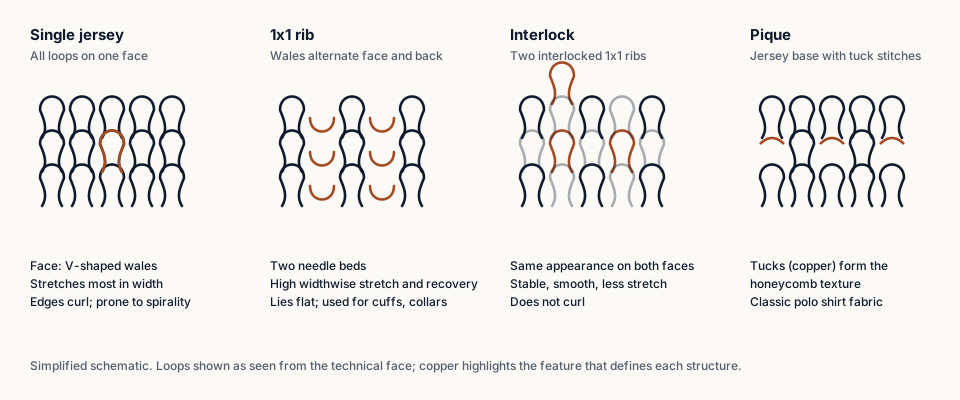
- The technical face shows columns of V-shaped loops called wales.
- The technical back shows rows of semicircular loop heads.
- A horizontal row of loops is a course.
Because every loop is formed the same way, the two faces look different, and the fabric is unbalanced. That is why single jersey curls at its cut edges and why it tends to twist.
Properties#
| Property | Single jersey behaviour |
|---|---|
| Stretch | Good widthwise stretch, less lengthwise |
| Recovery | Moderate; improved with elastane |
| Curling | Edges curl; cut panels roll |
| Twist | Prone to spirality, especially with single yarns |
| Runs | A broken loop can ladder along the wale |
| Hand feel | Soft and light; smooth face |
| Weight | Commonly 110 to 260 GSM (see the GSM chart) |
What controls weight and width#
Knitters set up single jersey with four main variables:
- Yarn count: finer yarn, lighter fabric.
- Machine gauge: needles per inch on the cylinder.
- Machine diameter: with gauge, sets the number of needles and the tube width.
- Stitch length (loop length): the length of yarn in each loop. This is the main setting used to reach a GSM target.
After knitting, the fabric relaxes and shrinks. Dyeing and finishing (compaction, stenter width, heat setting for synthetics) set the final width, GSM and shrinkage. A fabric forced to a width and weight by stretching on the stenter usually shrinks later.
The relationship between loops and weight is:
where is stitch length in mm and is yarn count in tex. The GSM calculator includes this method.
Common variants#
- Lycra (elastane) single jersey: elastane plated with the main yarn for stretch and recovery. Heavier and narrower after finishing.
- Slub jersey: slub yarn gives an irregular textured look.
- Melange or heather jersey: yarn spun from fibers dyed in different shades.
- Yarn-dyed stripes: made with feeders carrying different colors.
- Polyester and blends: common for sportswear, often heat set for stability.
Common problems#
Spirality#
Wales slant diagonally after washing, and the side seams of garments move towards the front. Caused mainly by the twist liveliness of single yarns, knitting conditions and relaxation. See fabric spirality and the spirality defect guide.
Curling#
Cut edges roll, which slows cutting and sewing. Handling methods, edge gumming on some fabrics, and correct relaxation reduce the problem.
Shrinkage#
Single jersey typically shrinks more in length than in width if it was stretched lengthways in processing. Controlled compaction and correct finishing reduce it. See fabric shrinkage.
Barre#
Horizontal bands caused by yarn lot mixing, count variation or unequal loop length between feeders. See barre.
Holes and laddering#
A broken yarn or a damaged needle causes a hole, which can run along the wale. Needle condition and yarn quality are the usual causes. See holes.
Sewing single jersey#
- Use ball point needles to push between yarns instead of cutting them, which avoids needle damage.
- Use extensible stitches: overlock for seams, coverstitch or flatlock for hems.
- Do not stretch the fabric while sewing, especially at necklines and shoulders.
- Add tape to shoulder seams where the style requires stability.
Specifying single jersey#
A clear fabric specification includes:
- Fiber composition and yarn type (combed, carded, compact, open end)
- Yarn count
- Finished GSM with tolerance
- Finished width (open or tubular)
- Shrinkage limits in length and width after the specified wash test
- Spirality limit after washing
- Colorfastness and pilling requirements
- Finish (softener, enzyme, peach, anti-pilling)