The global clothing market is led by a relatively small number of brands whose names are recognised almost everywhere. For people who work in garment manufacturing, these brands matter for a practical reason: they are the buyers whose orders, compliance programs and quality manuals shape how factories work.
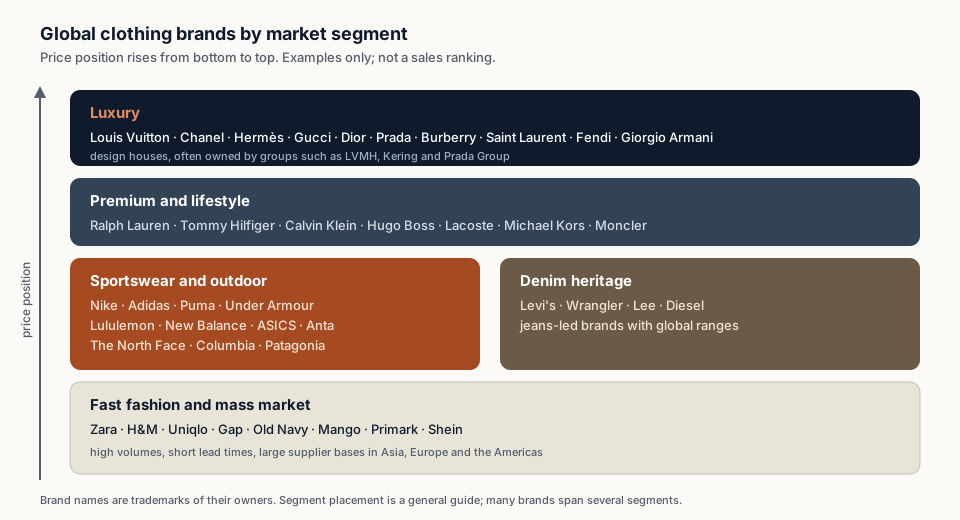
This list groups the best-known clothing brands by market segment. It is a reference list based on global recognition, international retail presence and influence on the apparel supply chain. It is not a ranking by sales or brand value; those figures change every year and are published by the companies and by specialist research firms.
Luxury brands#
Luxury houses sell at the highest price points, with tight control of design, materials and distribution. Many belong to large groups such as LVMH, Kering and Prada Group.
| Brand | Country | Founded | Parent group | Known for |
|---|---|---|---|---|
| Louis Vuitton | France | 1854 | LVMH | Leather goods, luggage, ready-to-wear |
| Hermès | France | 1837 | Hermès (family controlled) | Leather goods, silk scarves |
| Chanel | France | 1910 | Chanel (private) | Tweed jackets, couture, fragrance |
| Dior | France | 1946 | LVMH | Couture, ready-to-wear |
| Gucci | Italy | 1921 | Kering | Leather goods, ready-to-wear |
| Prada | Italy | 1913 | Prada Group | Nylon bags, ready-to-wear |
| Saint Laurent | France | 1961 | Kering | Tailoring, ready-to-wear |
| Fendi | Italy | 1925 | LVMH | Fur and leather, bags |
| Giorgio Armani | Italy | 1975 | Armani Group | Tailoring, soft suiting |
| Burberry | United Kingdom | 1856 | Burberry Group | Trench coats, check pattern |
| Balenciaga | Founded in Spain, based in France | 1917 | Kering | Couture heritage, streetwear influence |
Premium and lifestyle brands#
Premium brands sit between luxury and mass market. Many are built around a lifestyle image and sell through department stores, their own stores and licensing.
| Brand | Country | Founded | Parent group | Known for |
|---|---|---|---|---|
| Ralph Lauren | USA | 1967 | Ralph Lauren Corporation | Polo shirts, preppy American style |
| Tommy Hilfiger | USA | 1985 | PVH | Casual wear, red, white and blue branding |
| Calvin Klein | USA | 1968 | PVH | Underwear, jeans, minimalist style |
| Hugo Boss | Germany | 1924 | Hugo Boss AG | Suits, menswear |
| Lacoste | France | 1933 | Maus Frères | Pique polo shirts, crocodile logo |
| Michael Kors | USA | 1981 | Capri Holdings | Accessories, ready-to-wear |
| Moncler | Founded in France, based in Italy | 1952 | Moncler | Down jackets |
Sportswear and outdoor brands#
Sportswear is one of the largest and fastest-changing segments. These brands drive demand for performance fabrics, elastane knits, bonded seams and technical testing.
| Brand | Country | Founded | Known for |
|---|---|---|---|
| Nike | USA | 1964 (as Blue Ribbon Sports) | Footwear, performance apparel |
| Adidas | Germany | 1949 | Footwear, football, three stripes |
| Puma | Germany | 1948 | Footwear, football, lifestyle |
| Under Armour | USA | 1996 | Performance base layers |
| Lululemon | Canada | 1998 | Yoga and athleisure |
| New Balance | USA | 1906 | Running shoes, apparel |
| ASICS | Japan | 1949 | Running shoes and apparel |
| Anta | China | 1991 | Sportswear; its group also owns other brands |
| The North Face | USA | 1966 | Outdoor jackets; part of VF Corporation |
| Columbia Sportswear | USA | 1938 | Outdoor wear |
| Patagonia | USA | 1973 | Outdoor wear, environmental programs |
Denim brands#
Denim has its own heritage brands, many founded before modern fashion brands existed. See the dedicated list of top denim jeans brands for a much wider list.
| Brand | Country | Founded | Parent group | Known for |
|---|---|---|---|---|
| Levi's | USA | 1853 | Levi Strauss & Co. | The 501 jean, riveted denim |
| Lee | USA | 1889 | Kontoor Brands | Workwear heritage jeans |
| Wrangler | USA | 1947 | Kontoor Brands | Western and workwear jeans |
| Diesel | Italy | 1978 | OTB | Premium fashion denim |
Fast fashion and mass-market brands#
Fast fashion and mass-market retailers sell high volumes at accessible prices, with short development cycles. They are among the largest buyers of garments in the world and work with thousands of factories.
| Brand | Country | Founded | Parent group | Known for |
|---|---|---|---|---|
| Zara | Spain | 1975 | Inditex | Fast design-to-store cycle |
| H&M | Sweden | 1947 | H&M Group | Fashion at accessible prices |
| Uniqlo | Japan | 1984 | Fast Retailing | Basics, technical fabrics (fleece, thermal wear) |
| Gap | USA | 1969 | Gap Inc. | Casual American basics |
| Old Navy | USA | 1994 | Gap Inc. | Value family clothing |
| Mango | Spain | 1984 | Mango (private) | Women's fashion |
| Primark | Ireland (founded as Penneys) | 1969 | Associated British Foods | Low-price fashion and basics |
| Shein | Founded in China, based in Singapore | 2008 | Shein | Online ultra-fast fashion |
For menswear specifically, see top men's clothing brands you must know.
What makes a clothing brand "top"?#
There is no single measure. Common ways to compare brands include:
| Measure | What it shows | Limitation |
|---|---|---|
| Revenue | Scale of the business | Groups report many brands together |
| Brand value studies | Estimated value of the brand name | Methods differ between research firms |
| Store and online reach | Presence in markets | Does not show profitability |
| Recognition | How widely known the name is | Hard to measure consistently |
| Supply chain footprint | Number of supplier factories and countries | Rarely published in full |
Because each measure gives a different order, this list groups brands rather than ranking them.
What working with global brands means for suppliers#
For garment manufacturers, every major brand comes with a set of requirements that go well beyond the product itself:
- Code of conduct and audits: social, environmental and security audits before and during business. See buyer compliance audits.
- Chemical compliance: a restricted substances list and often a manufacturing restricted substances list. See restricted substances lists.
- Test programs: fabric and garment tests at approved laboratories, with the brand's methods and limits.
- Quality manuals: defect definitions, AQL levels and inspection procedures. See final inspection.
- Sustainability claims: recycled and organic content must be certified, for example under GRS.
- Costing and terms: most orders are priced FOB with detailed cost breakdowns. See FOB cost.
- Time and action plans: strict approval and delivery dates; see time and action plan.
Many brands do not own factories. They design, market and sell, and buy finished garments from manufacturers and from large textile groups; see top textile companies in the world.
Frequently asked questions#
Which is the largest clothing brand in the world? It depends on the measure. By apparel and footwear revenue, sportswear brands such as Nike are usually at or near the top; fast fashion groups such as Inditex and H&M Group are among the largest clothing retailers. Check the latest annual reports for current figures.
Do luxury brands make their own clothes? Some production is in their own workshops, especially leather goods, but much ready-to-wear is made by specialist manufacturers under the brand's control.
Why do many brands belong to the same company? Groups such as LVMH, Kering, PVH and Kontoor Brands own several brands to cover different segments and share resources such as sourcing and distribution.
Are brand names in this list trademarks? Yes. All brand names are trademarks of their respective owners and are used here only for identification.