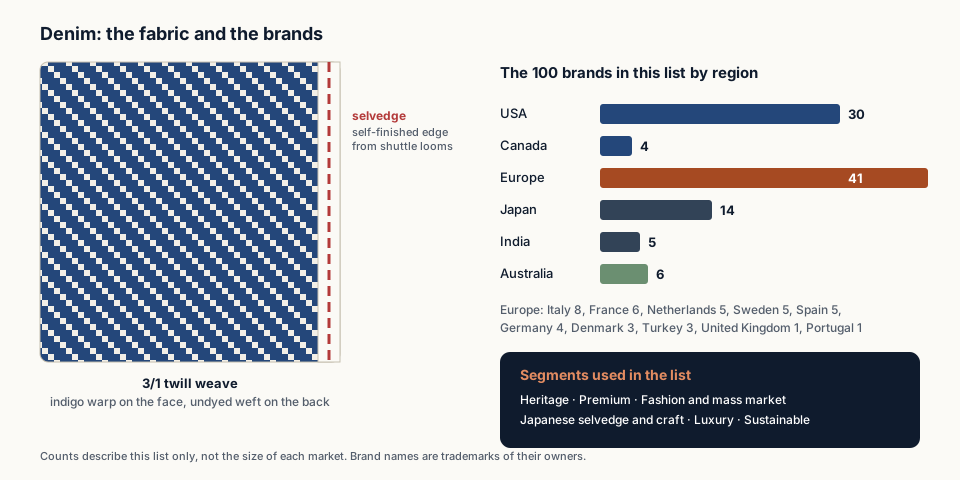
A reference list of 100 denim jeans brands from the USA, Europe, Japan, India, Canada and Australia, grouped by region with segment and what each is known for, plus a guide to denim segments, the fabric behind jeans and what denim brands expect from manufacturers.
Jeans are one of the few garments worn in almost every country, by almost every age group. Behind them is a large and varied group of brands: nineteenth-century American workwear pioneers, European fashion labels, Japanese craft makers weaving on vintage shuttle looms, and fast-growing brands in India and Australia.
This list covers 100 denim jeans brands, grouped by region. It is a reference list chosen for recognition, influence and variety across segments; it is not a ranking by sales or quality. Several of the brands are covered in more detail in the list of top clothing brands in the world.
Denim is a warp-faced twill; selvedge denim has a self-finished edge from shuttle looms.
Most jeans are made from denim: a warp-faced cotton twill, usually 3/1, with indigo-dyed warp yarns and undyed weft. The indigo is dyed on the outside of the yarn (ring dyeing), so the core stays white and fades with wear. That is why jeans develop whiskers and honeycombs.
Feature
What it means
Why brands care
Weight (oz/yd²)
Denim weight is usually quoted in ounces per square yard
Wash consistency: the same wash look across lots, approved against a wash standard.
Strong seams: chainstitch and safety stitch seams, bartacks, rivets and heavy threads. See stitch types.
Chemical compliance in washing and finishing, including restrictions on processes such as sandblasting, which many brands have banned for worker safety.
Sustainability claims backed by certification, for recycled or organic cotton.
Which is the oldest jeans brand? Levi Strauss & Co., founded in 1853. It received the patent for riveted work pants with Jacob Davis in 1873.
Why is Japanese denim so well regarded? Japanese mills kept narrow shuttle looms and traditional dyeing methods when much of the world moved to wide projectile looms, and many small brands built their reputations on heavy, characterful selvedge denim.
What is selvedge denim? Denim woven on shuttle looms, where the weft returns at each edge to form a clean, self-finished edge. It is usually narrower than denim from modern looms.
Is this a ranking? No. The brands are grouped by region to show the variety of the denim world. Rankings by sales or popularity change each year.
Are the brand names trademarks? Yes. All brand names are trademarks of their owners and are used here only for identification.
A reference list of the world's best-known clothing brands, grouped by segment: luxury, premium, sportswear, denim and fast fashion. Country, founding year and parent group for each, what they are known for, and what working with global brands means for garment suppliers.
The men's clothing brands every apparel professional should know, grouped by wardrobe category: tailoring, smart casual, workwear, heritage jackets, streetwear and sportswear. Country and founding year for each, what they are known for, and the fabrics and construction behind their signature products.
The major textile companies behind the world's clothing, grouped along the value chain: fiber producers, spinners, fabric mills and denim makers, and large garment manufacturers in China, India, Bangladesh, Pakistan, Sri Lanka, Vietnam, Turkey and elsewhere. What each does and how the industry is changing.
The main types of fabric used for dresses and everyday clothing: cotton, linen, silk, wool, viscose, polyester and blends, and the constructions made from them such as poplin, denim, satin, chiffon, crepe, jersey and velvet. Properties, typical weights, care and which garments each suits.