Garment finishing is everything that happens between the end of the sewing line and the container: trimming, inspection, repair, pressing, measurement checks, folding, tagging, packing and final inspection. It is the last chance to find and fix problems before the buyer sees the goods, and the stage where presentation is created: a well-pressed, correctly folded and packed garment.
Finishing often gets less engineering attention than sewing, yet it can become the bottleneck at the end of every order. This guide sets out the process flow, a layout that keeps work moving in one direction, and how to plan manpower.
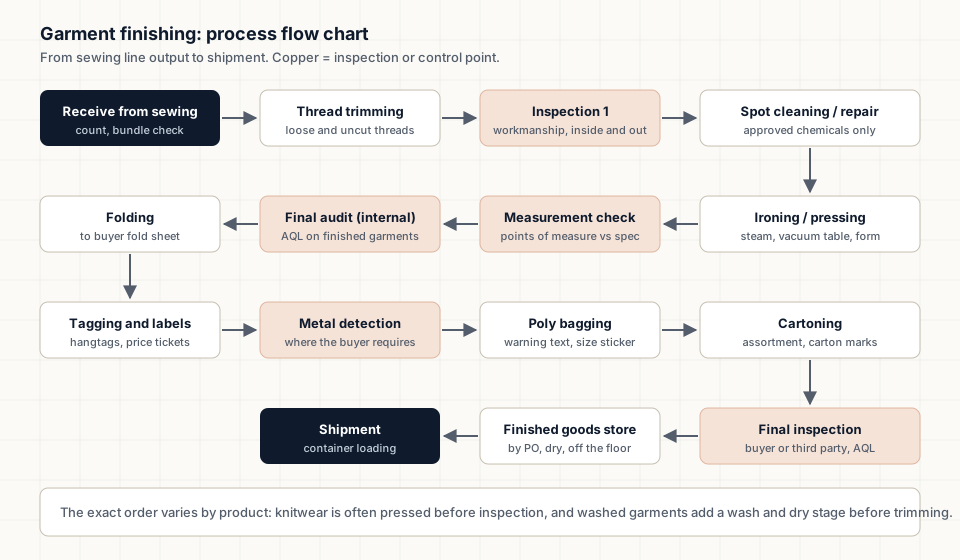
The finishing process step by step#
1. Receiving from sewing#
Garments arrive from the line in bundles or on a conveyor. Count them against the bundle ticket or line output, and record the quantity by style, color and size. Garments must not be mixed between orders or shade lots at this point; see shade variation.
2. Thread trimming#
Operators cut loose threads, thread chains and uncut tails inside and outside the garment. Automatic thread trimmers on sewing machines reduce this work but never remove it completely. Suction thread-sucking machines are used for loose threads on knits.
3. Inspection#
Every garment is checked for workmanship: open seams, skipped stitches, puckering, stains, holes, wrong labels and fabric faults. This is 100% inspection, not sampling. Defective garments are separated into marked bins by defect type and sent for repair or spot cleaning. Record defects so the cause can be fixed on the line; see inline inspection and DHU.
4. Spot cleaning and repair#
Repairable defects go back to a repair operator or the original line. Oil and dirt stains are removed with approved spot-cleaning chemicals only, used in a ventilated area. Spot removers must be on the factory's approved chemical list, because some solvents are restricted by buyers; see restricted substances lists.
5. Ironing and pressing#
Garments are pressed with steam irons on vacuum tables, or on form finishers and presses for jackets, trousers and shirts. Pressing sets creases, flattens seams and gives the final shape. Wrong temperature or pressure causes shine marks, scorching, shrinkage and damage to elastane or prints.
6. Measurement check#
Garments are measured at the key points of measure against the specification, usually on a sample from each size and color, and more often when problems appear. Out-of-tolerance measurements are a frequent reason for failing final inspection; see measurement variation.
7. Internal final audit#
A quality auditor checks a random sample of finished garments, often with the same AQL plan the buyer will use. This is the factory's own final check before packing. See AQL.
8. Folding#
Garments are folded to the buyer's fold instructions, usually with a folding board so every garment has the same size and look. Tissue paper, collar supports, clips and back boards are added where specified.
9. Tagging and labelling#
Hangtags, price tickets, size stickers and barcodes are attached as instructed. Check the tag position and barcode against the approved trim card; wrong tags are a common final inspection failure.
10. Metal detection#
Many buyers, especially for children's wear, require every garment to pass through a calibrated metal detector to catch broken needle fragments and other metal. The detector is checked with a test piece at set intervals, and every garment that triggers it is isolated and investigated. See needle breakage for broken needle control.
11. Poly bagging#
Garments go into polybags of the specified size and thickness, with suffocation warning text where required, and size stickers. Bags must be clean and dry.
12. Cartoning#
Garments are packed into cartons in the specified assortment (solid size or ratio pack), cartons are marked with the buyer's carton marks, weighed, sealed and strapped. Carton dimensions and weight must match the packing list. Moisture in packed goods causes mold during shipping, so check moisture before sealing; see moisture control management SOP for garments.
13. Final inspection, store and shipment#
The buyer or a third-party inspector carries out the final inspection on packed goods. Passed cartons are stored by purchase order on pallets, off the floor, in a dry area near the loading door, and loaded into the container.
Variations by product#
| Product | Main differences |
|---|---|
| Basic knit tops | Pressing is light or done with steam tunnels; thread sucking is common |
| Woven shirts | Collar and cuff pressing, buttoning, shirt folding with boards and clips |
| Trousers and jeans | Topstitch pressing, crease setting; washed styles add a wash, dry and repair stage before trimming |
| Jackets and outerwear | Form pressing, detailed inspection of linings, zips and trims |
| Hanging garments | Garments go on hangers with covers instead of being folded and bagged |
Layout of the finishing section#
A good finishing layout moves garments in one direction, from receiving to the finished goods store, without crossing back. The example below uses a U-shaped flow, so the receiving area and the finished goods store are both close to the main aisle and the loading door.
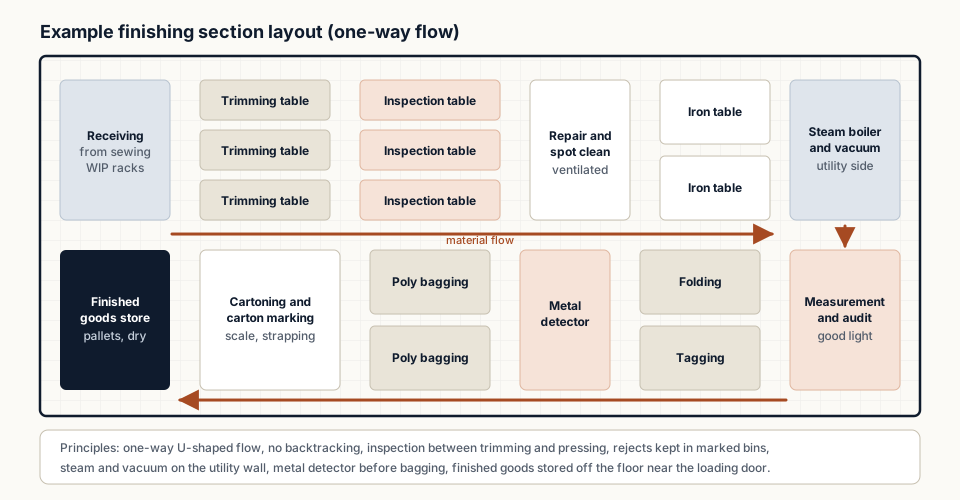
Layout principles#
- One-way flow: no backtracking of good garments. Only rejects move backwards, and only to a marked repair area.
- Inspection before pressing: pressing a garment that will be rejected wastes time; pressed garments that are repaired need pressing again.
- Utility wall: steam boilers, vacuum and compressed air lines along one wall keep piping short and aisles clear.
- Good light at inspection and measurement tables, with a light box for shade checks.
- Metal detector before bagging, so every garment passes it after the last handling of trims.
- Marked areas for rejects, work waiting and passed goods, so garments cannot be mixed.
- Finished goods off the floor, on pallets, in a dry and ventilated store.
- Clear aisles and fire exits, a requirement of every compliance audit.
Manpower planning for finishing#
Finishing manpower is planned from the daily output and the standard minutes of each finishing operation, the same way as for sewing:
Worked example#
A T-shirt order needs 2,400 pieces per day through finishing. The working day is 480 minutes and the planned efficiency is 70%, so each operator has 480 × 0.70 = 336 productive minutes. The finishing SMVs below are example values; use your own time studies.
| Operation | Example SMV (min) | Theoretical operators | Planned operators |
|---|---|---|---|
| Thread trimming | 0.30 | 2.14 | 3 |
| Inspection | 0.40 | 2.86 | 3 |
| Ironing | 0.60 | 4.29 | 5 |
| Folding | 0.35 | 2.50 | 3 |
| Tagging | 0.20 | 1.43 | 2 |
| Poly bagging | 0.25 | 1.79 | 2 |
| Cartoning | 0.10 | 0.71 | 1 |
| Total | 2.20 | 15.71 | 19 |
Add the repair operator, measurement checker, auditor, metal detector operator and supervisor as fixed positions. Use the manpower requirement calculator for other outputs. Planning finishing capacity together with sewing capacity avoids a pile of unfinished garments at the end of each order; see production planning basics.
Quality control points in finishing#
| Point | What to check | Record |
|---|---|---|
| Receiving | Quantity, bundle identity, shade lot | Receiving register |
| 100% inspection | Workmanship defects | Defect log by operation and line |
| After pressing | Shine, scorching, creases, shape | Spot checks |
| Measurement | Points of measure by size | Measurement sheet |
| Internal audit | AQL sample, all defect classes | Audit report |
| Metal detection | Detector calibration, rejects | Calibration and reject log |
| Packing | Assortment, carton marks, barcode scan, carton weight | Packing list and packing audit |
| Moisture | Moisture of garments and cartons before sealing | Moisture log |
Common mistakes that fail final inspection#
- Loose threads left after trimming, especially inside pockets and at seam ends.
- Measurement out of tolerance on one size because pressing stretched it.
- Wrong or missing tags, barcodes that do not scan, or tags on the wrong side.
- Mixed assortments or wrong carton quantities.
- Stains from dirty tables, oily machines or spot-cleaning rings.
- Damp cartons, which lead to mold and odor in transit.
- Shade differences between garments in the same carton.
Frequently asked questions#
Why is finishing called the last line of defense? Because it is the last place where the factory can find and fix defects before the buyer's inspection and the consumer.
Should every garment be pressed? It depends on the product and buyer. Many knit basics get light steam or none; woven shirts, trousers and jackets are pressed.
Is metal detection mandatory? It is required by many buyers and is standard practice for children's wear. Follow the buyer's requirements.
How many inspectors are needed in finishing? Enough to inspect 100% of output at the planned rate. With an inspection SMV of 0.40 minutes and 336 productive minutes per inspector, one inspector checks about 840 garments a day.