Fabric testing turns questions about a fabric into numbers: Will it shrink? Will the color run? Will it tear, pill or wear through? Does it breathe? Does it protect from the sun? Buyers set requirements for these properties, laboratories measure them with standard methods, and factories use the results to approve fabric before cutting.
This guide explains what each group of tests measures and how the main methods work. For a compact list of method numbers side by side, see ISO, ASTM and AATCC test methods.
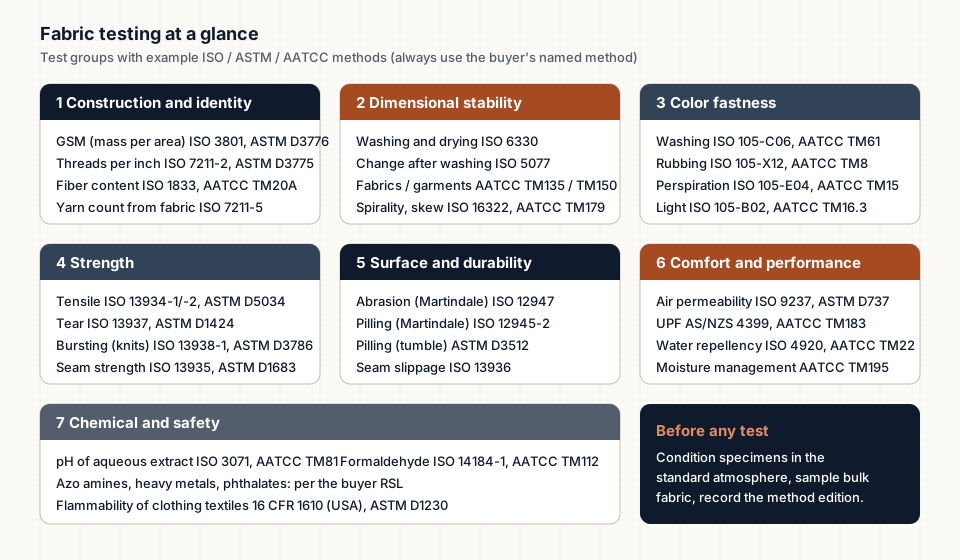
Why standard methods matter#
The same fabric can give different results under different conditions. A standard method fixes the conditions (specimen size, atmosphere, equipment, load, speed, number of cycles, how to grade), so that two laboratories testing the same fabric get comparable results. That is why a result must always be reported with the method that produced it.
Three families of methods dominate apparel testing:
| Organisation | Typical focus | Example |
|---|---|---|
| ISO | International methods across all property groups | ISO 105 series for color fastness |
| AATCC | Color fastness, wet processing, laundering, chemical | AATCC TM61 accelerated laundering |
| ASTM International | Physical properties and specifications | ASTM D5034 grab tensile |
Buyers name the methods, and often the edition, in their test manual. The factory's job is to send the right fabric, from the right lot, for the right tests.
Before any test: sampling and conditioning#
- Sample bulk fabric from the production lot, not lab dips or sample yardage.
- Take specimens away from the selvedge, creases and faults, as the method describes.
- Condition specimens in the standard atmosphere. ISO 139 defines the standard atmosphere for testing as 20 °C and 65% relative humidity, with set tolerances; ASTM D1776 describes conditioning for ASTM methods. Cotton, viscose and wool change weight and dimensions with humidity, so unconditioned results are unreliable.
- Record fabric quality, color, lot and roll numbers with every sample.
1. Construction and identity tests#
These confirm the fabric is what was ordered.
| Test | What it measures | Example methods |
|---|---|---|
| Mass per unit area (GSM) | Weight of a known area | ISO 3801, ASTM D3776 |
| Threads per unit length | Ends and picks, or courses and wales | ISO 7211-2, ASTM D3775 |
| Yarn count from fabric | Linear density of removed yarns | ISO 7211-5 |
| Fiber content | Blend percentages | ISO 1833 series, AATCC TM20A |
| Width | Usable width | ISO 22198 |
The factory can check GSM and construction in-house: see fabric GSM and fabric construction analysis. Fiber content claims on labels must match the tested composition within the tolerances allowed by the destination market's labelling rules.
2. Dimensional stability (shrinkage)#
Specimens are marked with benchmarks, washed and dried by a defined procedure, and measured again. The result is a percentage change in length and width. It is one of the most frequently failed tests, especially on cotton knits and viscose. The full procedure and a worked example are in fabric shrinkage test (dimensional stability).
For knits, the same wash test is often used to measure spirality or garment twist (ISO 16322 series, AATCC TM179). See spirality in knitted fabric.
3. Color fastness#
Color fastness tests check whether color changes, and whether it transfers to other materials, under washing, rubbing, perspiration, light, water and other agents. Results are graded from 5 (no change) to 1 (severe change) with grey scales.
| Agent | What happens in the test | Guide |
|---|---|---|
| Washing | Specimen with multifiber strip washed with detergent and steel balls | Color fastness to washing |
| Rubbing (crocking) | White cloth rubbed dry and wet on the fabric | Color fastness to rubbing |
| Perspiration | Soaked in artificial sweat, pressed, heated | Color fastness to perspiration |
| Light | Exposed to a xenon arc lamp against blue wool references | ISO 105-B02, AATCC TM16.3 |
The overview is in color fastness.
4. Strength tests#
| Test | Used for | How it works | Guide |
|---|---|---|---|
| Tensile strength | Woven fabrics | Strip or grab specimen pulled to break | Tensile strength |
| Tear strength | Woven fabrics | Force to continue a tear (pendulum or tongue methods) | ISO 13937, ASTM D1424 |
| Bursting strength | Knitted fabrics | Fabric bulged by a diaphragm or ball until it bursts | Bursting strength |
| Seam strength and slippage | Sewn seams | Seam pulled until it fails or opens | Seam strength |
5. Surface and durability tests#
Martindale abrasion#
The Martindale tester rubs circular fabric specimens against a standard abradant fabric under a set pressure. The specimen holders move in a Lissajous figure: a pattern that starts as a circle and gradually becomes a narrowing ellipse, so the fabric is rubbed evenly in every direction.
- Result: the number of rubs until the specimen breaks down. ISO 12947-2 defines breakdown for woven fabrics as two separate broken threads, and for knitted fabrics as a hole. Other parts of ISO 12947 measure mass loss or change of appearance after a set number of rubs.
- Load: the method specifies the pressure on the specimen; heavier loads are used for upholstery than for apparel.
- Check intervals: the operator stops at set rub counts to inspect the specimen, so the endpoint is found within an interval.
- Used for: workwear, trousers, school uniforms, denim, outerwear, and any product where durability is claimed.
ASTM D4966 is the ASTM Martindale method.
Pilling#
Pilling tests rub or tumble fabric to simulate wear, then grade the surface against photographs from 5 (no pilling) to 1 (dense pilling). The modified Martindale (ISO 12945-2), pilling box (ISO 12945-1) and random tumble (ASTM D3512) are the common methods. Details are in the pilling test guide.
Snagging#
Snag resistance is tested on fabrics prone to snagging, such as filament knits and loose structures, usually with a mace tester: a spiked ball tumbles against the fabric, and the snags are graded against photographs (for example ASTM D3939). Follow the buyer's named method.
6. Comfort and performance tests#
Air permeability#
Air permeability is the rate at which air passes through a fabric at a set pressure difference. It is a measure of how "breathable" a fabric is to air, which matters for sportswear, shirts, workwear, outdoor wear and technical textiles.
| ISO 9237 | ASTM D737 | |
|---|---|---|
| Principle | Air drawn through a clamped area at a set pressure drop | Same principle |
| Pressure drop | Chosen from values in the method; 100 Pa is commonly used for apparel | 125 Pa |
| Test area | Chosen from values in the method; 20 cm² is common | 38 cm² is the standard area |
| Result unit | mm/s | ft³/min/ft² or cm³/s/cm² |
Because pressure and test area differ between methods, results are only comparable within the same method and settings. Dense wovens and coated fabrics give low values; open knits and mesh give high values.
UV protection (UPF)#
The Ultraviolet Protection Factor (UPF) rates how much ultraviolet radiation a fabric blocks. A spectrophotometer measures how much UV passes through the fabric across the UVA and UVB wavelengths; the transmission is weighted by the sunburning effect of each wavelength and by a reference solar spectrum to calculate UPF. A fabric rated UPF 50 lets through about one fiftieth of the sunburning UV.
- Methods: AS/NZS 4399 (Australia and New Zealand), AATCC TM183 (transmittance measurement) together with ASTM D6544 (specimen preparation, which can include laundering and light exposure) and ASTM D6603 (labelling guide), and EN 13758-1 in Europe.
- What raises UPF: tighter construction, heavier fabric, darker and certain dyes, UV absorbing finishes, and fibers such as polyester.
- What lowers it: open structures, stretching (knits stretched on the body), and wetness for some fabrics.
- Claims: a UPF claim on a label must be supported by testing to the method required in the destination market.
Water resistance#
| Test | What it shows | Example methods |
|---|---|---|
| Spray test | Surface water repellency, graded against a chart | ISO 4920, AATCC TM22 |
| Hydrostatic pressure | Water pressure the fabric resists before leaking | ISO 811, AATCC TM127 |
| Rain test | Water penetration under simulated rain | AATCC TM35 |
Moisture management#
AATCC TM195 measures how liquid moisture spreads and moves through a fabric, which supports "wicking" and "quick dry" claims on sportswear.
7. Chemical and safety tests#
| Test | Why | Example methods |
|---|---|---|
| pH of aqueous extract | Residual acid or alkali from processing can irritate skin | ISO 3071, AATCC TM81 |
| Formaldehyde | From resin finishes and some binders | ISO 14184-1, AATCC TM112 |
| Restricted substances | Azo amines, heavy metals, phthalates, APEOs, PFAS and others | Per the buyer's RSL |
| Flammability | Safety of clothing textiles | 16 CFR 1610 in the USA, ASTM D1230 |
Chemical requirements come from laws and brand lists; see restricted substances lists and OEKO-TEX.
Building a test program by product#
Buyers usually define the test list by product type. The pattern below is typical; the buyer's manual is the authority.
| Product | Usual core tests | Added when relevant |
|---|---|---|
| T-shirts and knit tops | GSM, dimensional stability, spirality, color fastness (wash, rub, perspiration), pilling, bursting | Print durability, pH |
| Woven shirts and dresses | GSM, dimensional stability, color fastness, tensile and tear, seam slippage | Formaldehyde for easy-care finishes |
| Denim and bottoms | Dimensional stability, rubbing fastness, tensile and tear, seam strength | Martindale abrasion |
| Sportswear | Stretch and recovery, pilling, color fastness, air permeability, moisture management | UPF, chlorinated water fastness for swimwear |
| Outerwear | Water repellency, hydrostatic head, tear, abrasion | Seam taping and breathability tests |
| Children's wear | Standard physical and color tests | Flammability, small parts and chemical safety to the market's rules |
The fabric type decides which failures are most likely; the article on different types of fabric for dresses and clothing links common fabrics to the tests they most often fail.
Choosing a laboratory#
- Use laboratories accredited to ISO/IEC 17025 for the specific methods, when the buyer requires it.
- Check that the laboratory is on the buyer's approved list, if the buyer has one.
- Agree turnaround times and sample quantities in advance, especially for tests with several wash cycles or long exposures (such as light fastness).
Reading a test report#
- Identity: does the sample description (quality, color, lot) match the bulk?
- Method and edition: are they the ones the buyer requires?
- Conditions: wash program, drying method, number of cycles, pressure or load where relevant.
- Results per direction or specimen, not only an average.
- Pass or fail against the buyer's requirement, and any comments.
A failure should lead to a retest only when there is a reason to doubt the test. Otherwise, treat it as a production problem: find the cause and fix the fabric.
Frequently asked questions#
Which fabric test fails most often? In apparel, dimensional stability and color fastness (especially rubbing on dark shades) are among the most common failures.
Is an in-house test enough? In-house tests are valuable for quick control, but buyers usually require reports from accredited or approved laboratories for approval.
Can I compare an ISO result with an ASTM result? Not directly. Different specimen sizes, loads, pressures and grading make results non-comparable.
How often should fabric be tested? As the buyer's program requires, typically at development, for bulk fabric lots and sometimes on finished garments. Test new lots of fabric that behaved badly before.